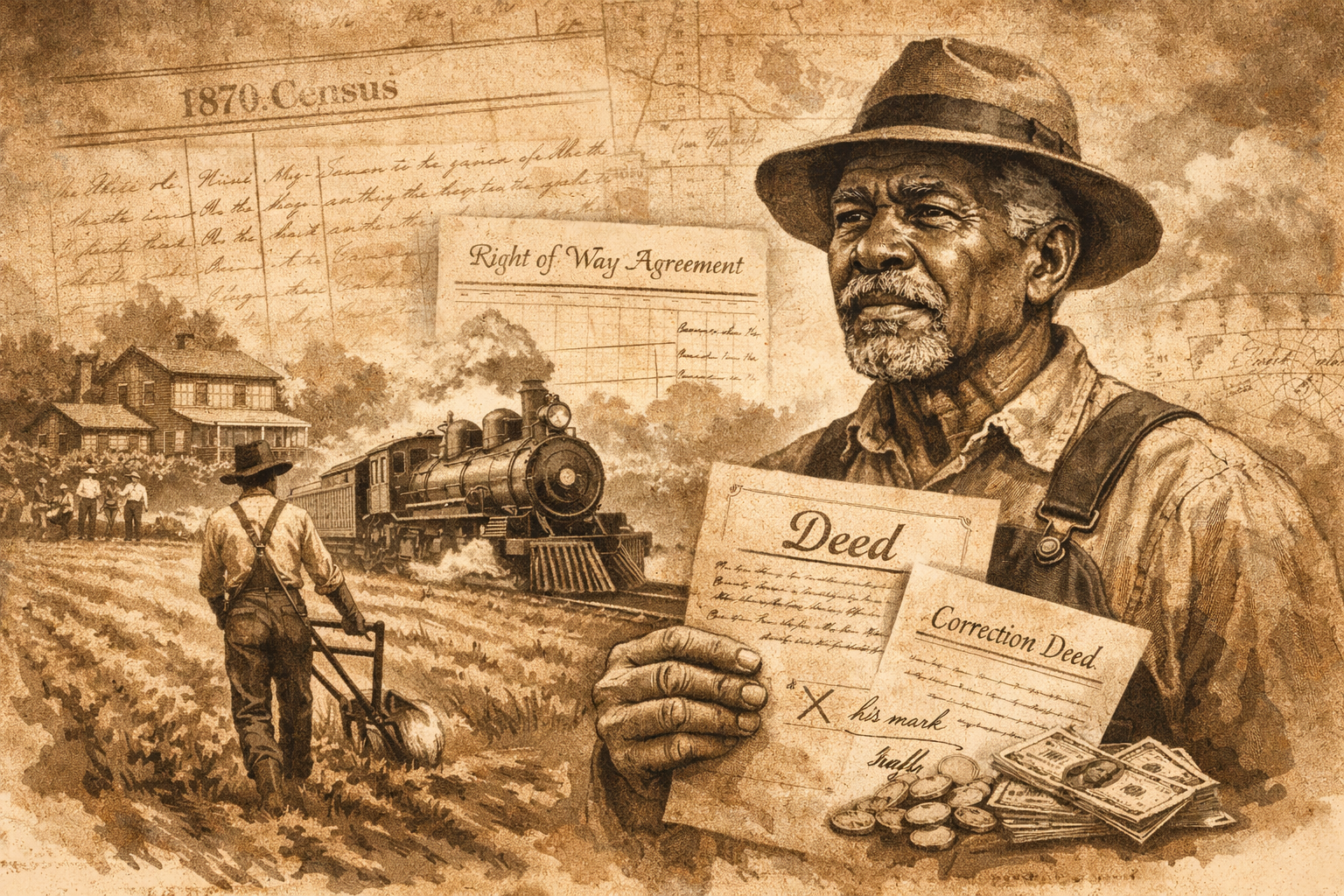
In the history of Newton County, Mississippi, we often hear about the promise of “Forty Acres and a Mule” — a promise that never truly materialized for most formerly enslaved families. Instead, the decades following the Civil War introduced a new form of economic bondage: the crop-lien system.
Under this system, farmers purchased seed, tools, and supplies on credit at inflated interest rates, with repayment due after harvest. A bad season, dishonest accounting, or falling cotton prices could mean another year trapped in debt. For many Black families, land ownership remained fragile. Mortgages multiplied. Deeds were lost. Foreclosure notices were common.
Yet buried in the deed books and newspaper archives of the early 1900s is the story of a man who not only survived that system — he mastered it.
His name was Allen Rigsby.
From Farm Laborer to Employer
Born around 1858 in the shadow of slavery, Allen Rigsby appears in the 1870 federal census as an eleven-year-old “farm laborer.” By age twenty, he was still working for others. The record notes that he could not read or write — a common reality for those born just before emancipation.
But over the next three decades, the documentary record reveals a dramatic shift.
By 1900, Allen was listed not merely as a farmer — but as a landowner whose farm was marked “F” for Free of mortgage. In an era when many Black farmers were entangled in crop liens and land notes, this detail is striking.
By 1910, the census described him as an Employer. He had moved from the man behind the plow to the man directing labor. The transformation was not symbolic — it was economic.
Even more remarkable, he maintained this “free and clear” status through the economic upheavals of the early twentieth century. Into his eighties, through the Great Depression, he continued working his own account — not someone else’s.
This was not luck.
It was strategy.
Strategic Leverage: The $125 Railroad Deal
In 1903, Allen Rigsby executed a Right-of-Way Deed with the Mobile, Jackson, and Kansas City Railroad Company. The railroad needed a 100-foot strip of land across his property.
Allen negotiated.
For that strip, he received $125.00 in cash.
In 1903, $125 represented more than a season’s wages for many laborers. For farmers caught in debt cycles, such funds might have been immediately absorbed by creditors. But Allen’s land was already free of mortgage. He had no lienholder waiting to collect.
Because he was debt-free, he retained the full benefit of that transaction — capital that could be reinvested in land, livestock, equipment, or family security.
While others were losing acreage to satisfy crop notes, Allen was converting land into leverage.
From Debtor to Creditor: The Bethel Community Trustee Sales
Newspaper clippings from 1914 reveal an even more significant dimension of Allen Rigsby’s economic standing.
Two Trustee Sale Notices were published in Newton County concerning land in Section 7, Township 6, Range 11 East.
The debtors were not white planters.
They were two Black farmers, brothers, along with their wives, from the Bethel Community:
- Lewis Walker and his wife, Cora Walker
- Charlie (Chas.) Walker and his wife, Mary Della Walker
On November 27, 1909, both couples executed deeds of trust to secure $650 owed to Allen Rigsby. The deeds were recorded in Newton County land records (Book 3, pages 318-319).
The sum of $650 in 1909 was sufficient to acquire approximately 130 acres of quality Mississippi farmland at the time (averaging $5 per acre). For Allen Rigsby to possess this amount of liquid cash to lend signifies that he was one of the wealthiest Black citizens in the county.

When default occurred, a substituted trustee was appointed, and in December 1914, the land — approximately forty acres in each case — was scheduled for public auction to satisfy the debt.
This is not a minor detail.
It tells us that by 1909:
- Allen had at least $650 available to lend — likely more.
- He was operating as a private lender within his own Black farming community.
- He used formal, recorded deeds of trust — not informal handshake agreements.
- He was legally protected within the county’s mortgage system.
$650 in 1909 was a substantial sum — equivalent to many thousands of dollars today. This was not a crop note for seed. This was capital secured by land.
This discovery reframes Allen’s position entirely.
He was not simply avoiding the crop-lien system.
He was participating in the credit structure from a position of authority.
Economic Complexity Within the Black Community
The Walkers were Black farmers from Bethel. That matters.
This was not a simple racial narrative of white creditor and Black debtor.
It reveals something more complex: within Black communities, there were internal economic hierarchies, capital flows, and financial relationships. Some accumulated surplus. Some struggled. Some borrowed to expand. Some defaulted.
Allen Rigsby had risen to a point where he could extend credit to others in his community.
And when repayment failed, he utilized the same legal foreclosure process that banks and white lenders used.
This is uncomfortable history for some — but it is real history.
Economic autonomy did not eliminate business risk. Nor did it eliminate legal enforcement.
What it does reveal is that Allen understood:
- Documentation
- Leverage
- Recorded security instruments
- Legal recourse
He was operating at a level of financial sophistication that defies the stereotype of the illiterate Black farmer of Jim Crow Mississippi.
Land-Literate in a World of Paper Barriers
The records consistently state that Allen “could not read or write.” In the legal culture of the early twentieth-century South, illiteracy was often weaponized against Black landowners.
Yet Allen was not defenseless.
He was land-literate.
He understood acreage, valuation, boundaries, contracts, and timing. He appeared before the Mayor of Newton to execute deeds, signing with his mark. He engaged in land swaps with members of the Evans family to consolidate holdings. When errors surfaced in earlier filings, he pursued Correction Deeds in 1919 — ensuring that his son, James Rigsby, inherited a legally secure estate.
He may not have read books.
But he read deeds.
He read risk.
He read opportunity.
His literacy was measured not in penmanship, but in permanence.
Patriotism and Financial Strength: The Liberty Bond Honor Roll
Further confirmation of the Rigsby family’s financial stability appears during World War I.
A Newton County newspaper published an Honor Roll of citizens who purchased Liberty Bonds to support the war effort. Among the names listed were:
- Allen Rigsby
- W.A. Rigsby
- James (Jim) Rigsby
Three generations purchasing bonds.
Liberty Bonds were not symbolic gestures. They required disposable income. They represented surplus capital willingly invested in federal securities.
At a time when many Black farmers were still struggling with crop liens and land notes, the Rigsby family was purchasing government bonds in sufficient amount to be publicly acknowledged.
That is not survival.
That is stability.
Beyond Survival: Engineering Independence
Allen Rigsby’s life complicates simplistic narratives of victimhood in the post-Reconstruction South. The system was undeniably stacked against Black landowners — economically, legally, and socially. Many were dispossessed through no fault of their own.
Yet Allen demonstrates another truth: within oppressive structures, some individuals found ways to maneuver, protect, expand, and even finance others.
He did not inherit freedom in its fullness.
He engineered it.
Through:
- Debt avoidance
- Strategic negotiation
- Recorded security instruments
- Enforced contracts
- Correction deeds
- Intergenerational planning
- And disciplined labor tied not to someone else’s ledger, but to his own soil
He moved from farm laborer to employer.
From borrower to lender.
From surviving the system to operating within it.
Every time we examine the land in Sections 17 and 20 of Newton County, we are not simply looking at acreage on a plat map.
We are looking at documentation of endurance — and economic intelligence.
Allen Rigsby did more than acquire land.
He secured autonomy.
He did more than hold property.
He mastered the deed.
And in doing so, he planted roots deep enough that they continue to hold the soil today.
Sources & Research Notes
Archival Records: > * Newton County, MS Deed Books 3, 8, 13, 14, 18, 23, 26, 28, 31, 37, 44, & 47 (1877–1922).
- Right-of-Way Deed: Rigsby to M.J. & K.C. Railroad Co. (Jan 7, 1903).
Census Data: > * U.S. Federal Census, Newton County, MS: 1870 (Township 5), 1880–1940 (Beat 4).
- The Newton Record, Trustee Sale Notice, Thu, Nov 26, 1914 ·Page 6
- The Newton Record, Newton County Has Taken her Quota, Thu, May 02, 1918 ·Page 1
- The Newton Record, Trustee Sale Notice, Thu, Dec 10, 1914 ·Page 3
- The Newton Record, Trustee Sale Notice, Thu, Dec 03, 1914 ·Page 3
Historical Context: > * For more on the crop-lien system and Black land ownership in Mississippi, see our methodology page: Following the Names.
Leave a Reply