The Myth of the Great Divide
When we look back at the decades before the Civil War, it is easy to imagine a simple binary: you were either enslaved or you were free. But the historical record reveals a far more complex—and often unsettling—reality.
Across the South, thousands of African Americans lived in what can best be described as a third space—legally free, yet constrained by laws, economics, and constant oversight. These individuals were known as “Free People of Color,” and their lives demonstrate a critical truth:
In a slave society, freedom did not always mean independence.
Reading Freedom in the Records
One of the most reliable ways to identify free Black individuals before the Civil War is through the 1850 United States Census.
In 1850, census takers used two separate systems of documentation:
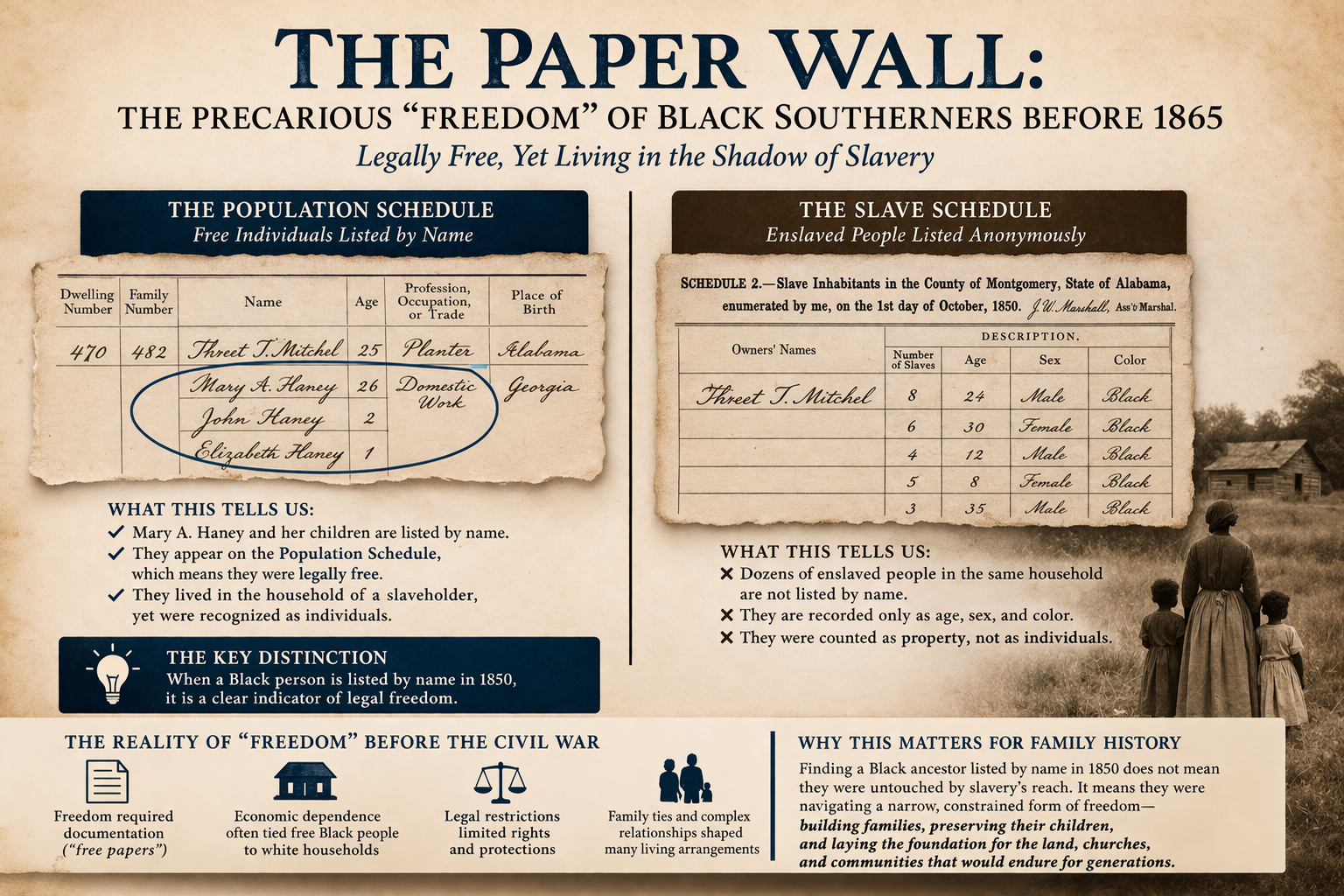
- The Population Schedule recorded free individuals—Black and white—by name, age, occupation, and household.
- The Slave Schedule recorded enslaved people anonymously, listing only age, sex, and color under the name of the slaveholder.
This distinction is one of the most important tools available to historians and genealogists.
When a Black individual or family appears by name in the population schedule—even within a white household—it indicates legal freedom. At the same time, it often signals a deeper and more complicated relationship to the institution of slavery.
A Case Study in Contrast: Mary A. Haney
The experience of Mary A. Haney offers a clear example of this reality.
In 1850, Mary appears as a 26-year-old Black woman living in Montgomery County, Alabama, in the household of Threet T. Mitchel. She is listed alongside two young children—John and Elizabeth—who were also recorded by name.
Because they appear in the population schedule, we know that Mary and her children were legally free.
Yet a look at the slave schedule for that same household reveals that Threet Mitchel also held dozens of enslaved individuals—men, women, and children who were not named, but instead recorded as property.
The contrast is striking:
- The Enslaved: Unnamed, counted as property on one ledger
- The Haneys: Named, recognized as individuals on another
And yet, both existed within the same household, under the same authority.
The “Paper Wall” of Freedom
If Mary was free, why was she living in the household of a slaveholder?
The answer lies in what might be called the “paper wall” of freedom—a system in which legal status existed, but was fragile, conditional, and constantly at risk.
1. Freedom as Documentation
Freedom was not simply a condition—it was something that had to be proven.
Free Black individuals were often required to carry legal documents verifying their status. Without these papers, they could be detained, challenged, or treated as fugitives if they could not prove their freedom.
2. Economic Constraint
Legal freedom did not guarantee economic independence.
Most free Black individuals:
- Did not own land
- Had limited access to skilled trades
- Faced restrictions in employment
As a result, many worked for or lived with white families, including slaveholders. These arrangements were often less a matter of choice than of survival.
3. Proximity to Slavery
Free Black families frequently lived:
- On or near plantations
- Within communities structured around enslaved labor
- In close physical and social proximity to slavery
Freedom, in this sense, existed within—not outside—the system.
4. Kinship and Unspoken Histories
Some relationships between free Black women and white households reflected deeper and more complex realities.
In certain cases, these arrangements were shaped by:
- Prior enslavement
- Long-standing labor relationships
- Family ties that were not formally recognized in law
- Systems of coercion that remain difficult to document directly
The historical record is often silent on these dynamics—but their presence is widely acknowledged by historians studying the period.
5. Legal Limitations
Even as free individuals, Black men and women faced significant legal barriers. In many Southern states, they:
- Could not vote
- Could not testify against white individuals in court
- Faced restrictions on movement and residency
- Lived under laws that could change or tighten without warning
Their freedom existed—but it was tightly controlled.
Were They Truly Free?
Legally, yes.
In practice, their lives were shaped by limitation, vulnerability, and constant negotiation.
Free Black individuals could:
- Marry and maintain family units
- Be recognized by name in official records
- In some cases, acquire property
But their freedom was never fully secure. It depended on documentation, circumstance, and the willingness of the surrounding society to recognize it.
Freedom, in this context, was not a guarantee—it was a condition that had to be maintained.
Why This Matters for Family History
Understanding free Black status before the Civil War fundamentally changes how we interpret historical records.
When an ancestor appears by name in the 1850 census:
- It does not mean they were economically secure
- It does not mean they lived outside the influence of slavery
- It means they were navigating a narrow and constrained form of freedom
For families like the Haneys—and many others across Mississippi and Alabama—this distinction helps explain:
- Why individuals appear in white households
- Why some family lines remain traceable while others are fragmented
- How families preserved continuity under unstable conditions
Beyond the Paper Wall
The story of free Black life before the Civil War is not a story of full liberation—it is a story of endurance within limitation.
People like Mary A. Haney lived in a world where:
- Freedom existed on paper
- Control shaped daily life
- Survival required strategy, resilience, and adaptation
They were not outside the system of slavery—they were navigating its edges.
And in doing so, they built something lasting.
They built families.
They held onto their children.
They established roots in places like Clarke County and Newton County.
And from that fragile, constrained beginning, they laid the foundation for the land ownership, church communities, and family networks that would sustain future generations long after emancipation.
Leave a Reply