In genealogical research, we often expect a straight line from birth to death. We expect records to align neatly — birth certificate, census, marriage, death. A name should follow a person faithfully from cradle to grave.
But for many African Americans born in the late nineteenth and early twentieth centuries, that line is rarely straight.
It bends.
It shifts.
It sometimes splits in two.
Tracking an ancestor can feel like chasing a shadow — especially when military records list one name while family Bibles and census schedules list another.
Before we assume error, we must understand context.
In Mississippi and across much of the South, birth certificates were not mandated until 1912. Before widespread government-issued identification, there were few legal mechanisms regulating name changes. A person could adopt, modify, or revert to a surname without reporting it to any central authority.
While alternate names were common among men enlisting for World War I, name fluidity long predated military paperwork.
The Root of the Name Gap
1. The “Bureaucratic Filter” (Clerical Recording)
Most draft boards and enlistment offices were staffed by white registrars who often recorded names based on what they heard — or what they assumed.
- A surname could be misheard.
- A maternal name might be recorded instead of a paternal one.
- Spelling could shift permanently with the stroke of a pen.
Once typed onto a service card, that name became the soldier’s official federal identity — accurate or not.
2. The Weight of History: Multiple Surnames
In the decades after Emancipation, African American naming traditions were layered and complex. One individual might carry:
- A father’s surname
- A mother’s maiden name
- The surname of a former enslaver
- A community nickname
A young man might use one name locally in Newton County and another when interacting with federal institutions.
Names were not always rigid legal anchors.
They were social tools.
3. Autonomy and Reinvention
For many Black men, military service marked their first formal step beyond the rigid hierarchies of their hometowns.
Choosing — or accepting — an alternate surname could:
- Create distinction from others with the same name
- Reflect maternal lineage
- Offer a sense of reinvention
- Reduce confusion in pay or service rolls
Sometimes the change was clerical.
Sometimes it was intentional.
Often, we cannot tell which.
4. The “Jim Crow” Shield
In an era of intense racial surveillance, reputation mattered.
An alternate surname could, in some cases, provide distance from:
- Local debts
- Prior disputes
- A family name already marked in white community memory
We must be cautious not to overstate this — but in a system where names carried social weight, flexibility had value.
The Post-War Reversion: Coming Home to the “Right” Name
One of the greatest challenges for researchers is what might be called the post-service reversion.
After the war, many veterans returned home and resumed the surname their families had always known.
To the federal government, one name existed.
To the community, another.
Without intentional comparison, those identities remain divided on paper. This phenomenon explains why a descendant might stand in a family cemetery and see a name on a government-issued headstone they have never heard before — a federal name for a local hero.
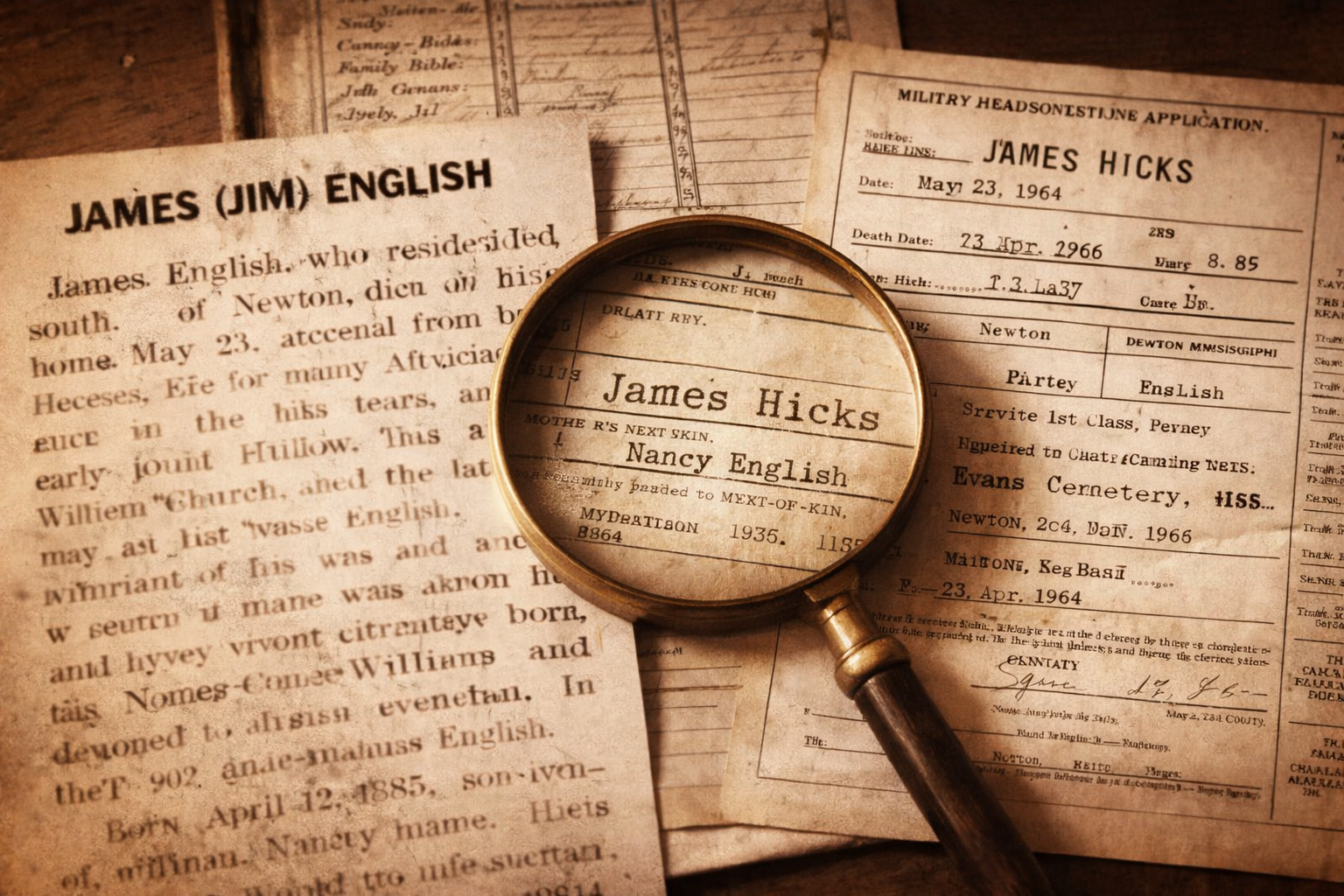
A Case Study: James (Jim) English / James Hicks
Consider the case of James (Jim) English of Newton County, Mississippi.
A 1964 obituary identifies him as:
- Born April 12, 1885
- Son of William and Nancy English
- World War I veteran
- Married to Myra Evans English
- Buried in Evans Cemetery
- Died May 23, 1964
The obituary clearly preserves his identity as James English.
But his military record tells a different story.
World War I service and headstone application records list:
- Name: James Hicks
- Birth Date: April 12, 1887
- Unit: Company A, 508th Engineers (Colored), U.S. Army
- Death Date: May 23, 1964
- Burial: Evans Cemetery
- Mother: Nancy English
At first glance, these appear to be two separate men.
But look closely:
- The mother’s name matches: Nancy English.
- The death date matches exactly: May 23, 1964.
- The burial location matches.
- The birth date differs by only two years — a common discrepancy in early records.
The conclusion becomes clear:
James Hicks and James English are the same man.
To the U.S. Army, he was James Hicks.
To Newton County, he was James English.
Without reconciling the maternal link, his military service might have been permanently disconnected from his family’s history.
| Category | Newspaper Obituary (1964) | Military/Headstone Record |
| Name | James (Jim) English | James Hicks |
| Birth Date | April 12, 1885 | April 12, 1887 |
| Death Date | May 23, 1964 | May 23, 1964 |
| Mother | Nancy English | Nancy English |
| Burial | Evans Cemetery | Evans Cemetery |
The English/Hicks case illustrates military name divergence. But not all archival splits begin with war service.
A Second Pattern: Sullivan → Selby Anderson
Another Newton County case reveals a different but equally instructive pattern.
In early census records (1900 and 1910), John L. “Selby” Anderson appears as “Sullivan” Anderson, born August 1896.
Yet later records tell another story.
- His Social Security application lists his birth as August 14, 1886.
- His World War I Draft Registration lists August 14, 1896, in Lake, Mississippi.
- Newspaper accounts repeat the 1886 date.
Not only does the birth year shift by a decade —
the given name shifts entirely.
Sullivan.
Selby.
Two names.
One man.
Which is correct?
The census and draft card align with 1896.
The Social Security application and obituary repeat 1886.
When examined collectively, the earlier records likely carry greater evidentiary weight. The later discrepancy may reflect memory drift, clerical standardization, or self-representation over time.
The shift from Sullivan to Selby may have been:
- A phonetic shortening
- A community nickname formalized
- A clerical reinterpretation
- Or a personal reinvention
We may never know.
But without reconciling those documents, Selby’s early life would remain disconnected from his adult identity.
This is how archival shadows form.
And this is how they are resolved.
What This Means for Researchers
If you have hit a “brick wall” in your research, consider:
- Search by first name and birth date, not surname alone.
- Compare mothers’ or father’s names across documents.
- Review headstone applications carefully.
- Check burial locations.
- Study next-of-kin information on draft cards.
Sometimes the key is not the surname.
Sometimes it is the mother or father.
Why This Matters
These alternate names are more than clerical inconsistencies.
They reflect how African American men navigated federal systems that did not always reflect their lived identities. They reflect adaptation, survival, and sometimes reinvention.
When we reconcile those names, we are not simply correcting a record.
We are restoring wholeness.
We are ensuring that a veteran’s service, a family’s memory, and a community’s history are not separated by the stroke of a registrar’s pen.
In Newton County — as in countless Southern communities — the archive does not erase identity. It merely fragments it.
Our task is to piece it back together.
In genealogy, the line may not be straight.
But with patience — and careful reading — even shadows can be traced.
Leave a Reply