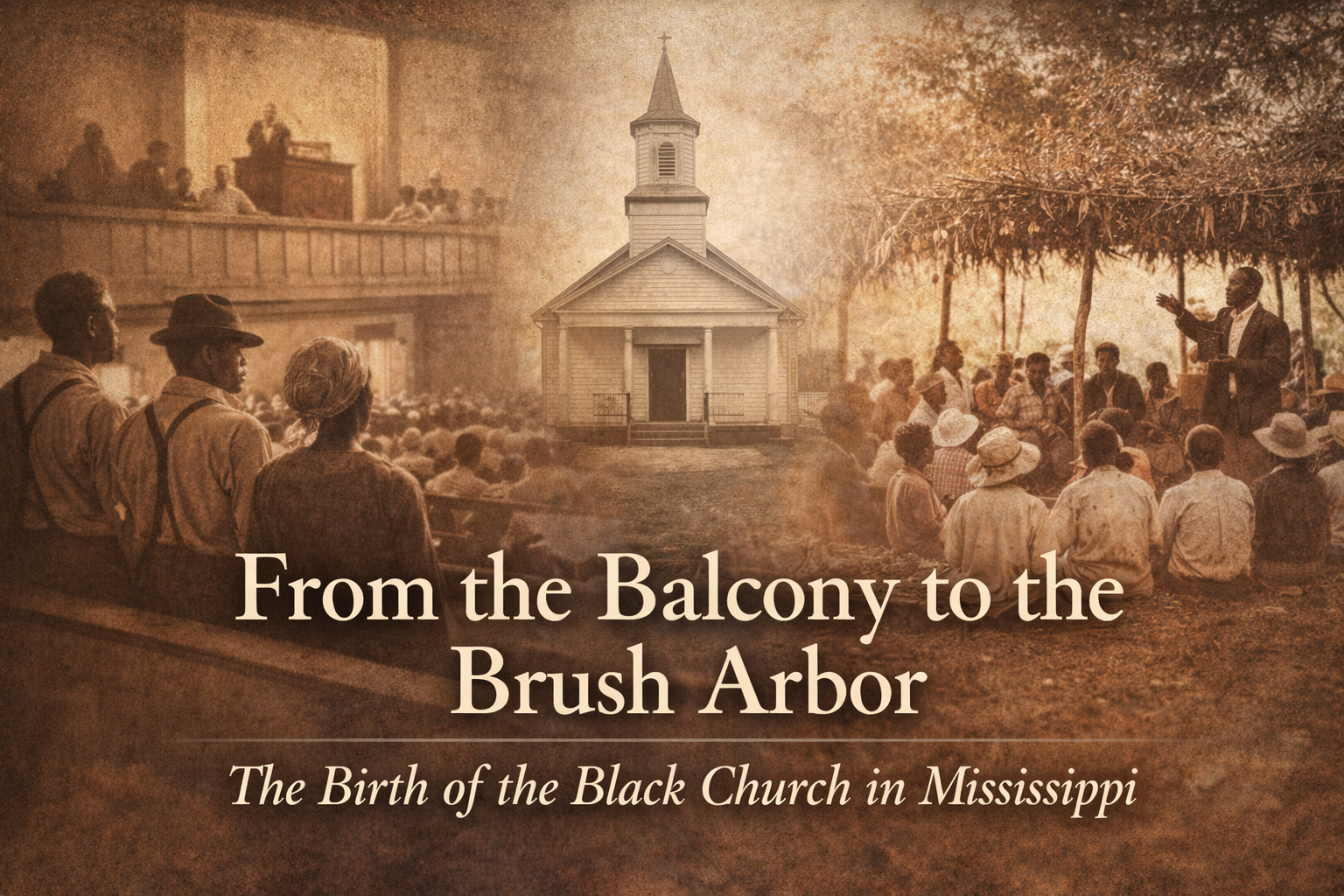
Before the Civil War, the Black church in Mississippi was often a church within a church — a congregation worshipping under watchful eyes. Faith existed, but it was regulated. Praise was permitted, but autonomy was not.
In many Mississippi counties, enslaved African Americans attended the churches of their enslavers, seated in balconies, corners, or segregated galleries. They heard the same sermons but did not share the same space. Even in rare instances when separate services were allowed, they were held under white supervision to ensure that the message of “freedom” remained spiritual — never social, never political.
Yet even within those restrictions, something powerful was forming.
The Segregated Sanctuary in Newton County
In Newton County, one of the clearest windows into this era comes from Bethel Baptist Church and the Chapman plantation. In a 1960 interview with The Newton Record, Mary Chapman — daughter of Richard “Dick” Chapman and Lucy Thompson Chapman — recalled attending services where Black congregants were required to sit separately while Rev. Shelby King preached to a divided house.
The physical separation was visible. But so was the quiet endurance of a people who listened, interpreted, and internalized the Gospel in ways that transcended the walls around them.
These worship experiences were not equal — but they were formative.
The Separation That Was Coming
When Emancipation arrived, the shift was gradual but inevitable.
Many white church members expressed a desire for African Americans to remain within their congregations — but not as equals. At the same time, freed men and women longed for something deeper than proximity. They sought autonomy: the right to preach, to organize, to own land, to decide what the pulpit would say.
For white leaders during Reconstruction, supporting the formation of separate Black churches often served a practical purpose. Encouraging religious instruction was seen as a way to maintain social order in a fragile post-war South.
For freed people, however, a separate church was not about order — it was about ownership. It was the first institution they could control.
The split was not merely theological. It was structural. It marked the beginning of self-governed Black institutions across Mississippi.
Faith as a Freedom Journey
For newly freed African Americans, Christianity was not abstract doctrine. It mirrored their lived experience.
While many white Southerners attributed Confederate defeat to military errors by leaders like Lt. Gen. John C. Pemberton, Black communities interpreted the end of the war differently. They saw it as divine intervention.
The Exodus story became personal. Moses was not distant history — he was a reflection of their own passage from bondage to freedom.
Emancipation was not simply a political event. It was spiritual confirmation.
This conviction fueled the rapid growth of Baptist congregations across Newton County and beyond.
The Rise of Black Clergy
In Newton County, Rev. Abram Donald stands as the first recorded Black minister preaching in the area. His leadership marked the beginning of a new religious era — one led by men who no longer required white oversight to interpret Scripture.
These ministers were more than preachers. They were organizers, teachers, farmers and protectors of community memory.
Under their leadership, the Black church quickly expanded its role.
Churches as Community Strongholds
Across Newton County, African American churches became far more than sanctuaries.
They were:
• Schools when public education was denied
• Meeting spaces during racial tension
• Centers for mutual aid and burial societies
• Platforms for civic organization
• Cultural anchors preserving music, leadership, and tradition
In a time when legal and political systems offered little protection, the church became the one institution rooted in faith, land, and collective strength.
The brush arbor became a schoolhouse.
The pulpit became a podium.
The sanctuary became a safe haven.
Why This History Still Matters
The early Black churches of Newton County were not simply buildings. They were declarations of independence.
They represent one of the first sustained acts of institutional self-determination by formerly enslaved people in this region.
Every pastor who stands in those pulpits today, every choir that lifts its voice, and every family that gathers for homecoming services participates in a legacy born from separation, resilience, and faith.
The Black church was not born out of preference — it was born out of necessity.
And from that necessity came strength.
If your family carries stories of the early days of your church’s founding, we invite you to share them. These memories are part of the living archive of Newton County.
Leave a Reply