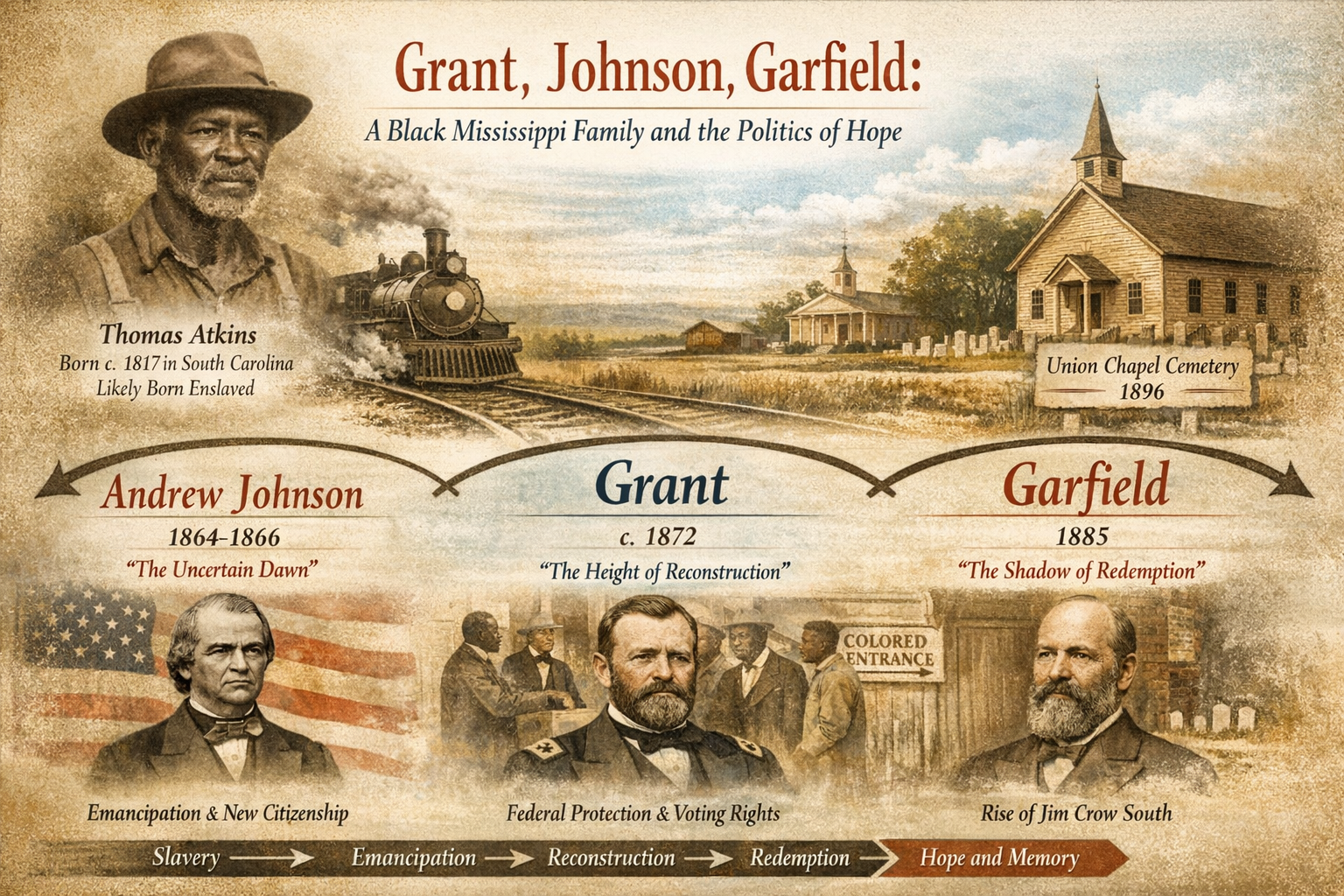
In the late nineteenth-century census records of Neshoba and Newton Counties, Mississippi, three presidential names appear across one extended Black family: Andrew Johnson, Grant, and Garfield.
At first glance, they may seem like ordinary given names. But placed within the political landscape of the Civil War, Reconstruction, and the rise of Redemption, they form a pattern that invites deeper reflection.
Before those names were given, there was another—Thomas Atkins.
Born on May 8, 1812, in South Carolina, Thomas was likely born into slavery. By 1870, he appears in Beat 4, Neshoba County, Mississippi, at age 53, unable to read or write, listed simply as a farmer. He lived through the bonds of slavery, the turmoil of war, and the uncertain dawn of Reconstruction. Among his children were boys named Andrew Johnson and Grant — and in the next generation, his grandson Garfield.
A Patriarch Between Two Worlds
Thomas Atkins represents what might be called a hinge generation.
He was born into a world where Black citizenship was legally impossible. Yet by the 1870 census, he was recorded as a “male citizen over 21.” That single line signals a monumental transformation: a man once legally classified as property was now recognized, at least on paper, as part of the American civic body.
Thomas could not read or write, but he possessed the power to name. In a society that had long stripped enslaved people of control over identity and lineage, naming could become an act of reclamation — and perhaps even quiet assertion of belonging.
The Naming Timeline: A Map of Hope and Retreat
The presidential names that appear within the Atkins-Adkins family align strikingly with the political arc of Reconstruction.
1. Andrew Johnson: The Uncertain Dawn (1864–1866)
Andrew Johnson Adkins was born between 1864 and 1866 — at the close of the Civil War and in the earliest phase of Reconstruction.
In April 1865, following Abraham Lincoln’s assassination, Andrew Johnson became president. At that moment, Johnson was widely known as a Southern Unionist and Lincoln’s chosen partner on the National Union ticket. His later resistance to Congressional Reconstruction and civil rights legislation had not yet fully reshaped his reputation in rural Mississippi.
If Andrew Johnson Adkins was named in 1865 or early 1866, the choice likely reflected that transitional moment — the end of slavery, the promise of national reunification, and the first fragile sense of citizenship. The name may have symbolized entry into a new political order, even before its limitations became clear.
2. Grant: The Peak of Protection (c. 1872)
By 1872, another son bore the name Grant Adkins.
Ulysses S. Grant, president from 1869 to 1877, presided during the height of Reconstruction enforcement. Under his administration:
- The 15th Amendment was upheld.
- Federal troops remained in parts of the South.
- The Enforcement Acts were used to suppress Ku Klux Klan violence.
In early 1870s Mississippi, Black men voted and held public office at levels that would not be seen again for generations.
The name Grant, given during this period, aligns closely with that environment of federal protection. It suggests attentiveness to national leadership and perhaps hope in the continued shield of federal authority.
3. Garfield: Hope in the Shadow of Redemption (1885)
By 1885, when Garfield Adkins was born, the political landscape had changed dramatically.
The era of “Redemption” had begun. In Mississippi, the Mississippi Plan of 1875 had violently dismantled Black political power. Federal troops had withdrawn. The foundations of Jim Crow were forming.
James A. Garfield, assassinated in 1881, had expressed support for Black education and citizenship. His death, like Lincoln’s before him, transformed him into a symbol of interrupted promise.
In the rural Lawrence community of Newton County — near the Vicksburg and Meridian Railroad line, where news and national events traveled by telegraph and train — the name Garfield may have carried layered meaning. It may have functioned as remembrance of a federal commitment that had once seemed possible.
From Atkins to Adkins: Identity and Literacy
The family’s transformation is also visible in the evolution of their surname.
In early records, the name appears as Atkins. By 1900, it consistently appears as Adkins.
This shift likely occurred at the intersection of phonetic spelling and increasing literacy. While census takers may have recorded the name as they heard it, later generations — including Thomas’s son George — appear as literate and landholding by the turn of the century.
As literacy expanded, so too did the ability to standardize and claim one’s own name in the written record.
The transition from Atkins to Adkins represents more than orthography. It reflects growing agency over identity itself.
The Geography of Awareness
Thomas Atkins spent his final years in the Lawrence community of Newton County. Living near a major rail line meant the family was not isolated from national currents. Presidential deaths, federal legislation, and political shifts would have traveled along those tracks.
The “Politics of Hope” in this household were not abstract. They were tied to real events unfolding in Washington and reverberating in Mississippi.
Within one extended family, we see a generational arc:
Slavery → Emancipation → Reconstruction → Redemption → Land Ownership → Literacy.
The names trace that arc alongside it.
Conclusion: Naming as Historical Memory
We cannot know with certainty what Thomas Atkins intended when his sons were named. No diaries or letters survive to explain the choices.
But the repetition of presidential surnames across three pivotal decades is difficult to dismiss. The pattern invites interpretation.
In a world where the ballot was increasingly threatened and political voice narrowed, naming a child may have been one of the few enduring declarations available.
Not a speech.
Not a vote recorded in public.
But a name written into the next generation.
Thomas Atkins died in 1896 and was laid to rest at Union Chapel United Methodist Church in Lawrence. He did not live to see the full entrenchment of Jim Crow. Yet across the census pages of his descendants, presidential names echo through the decades — reminders that even in the shadow of Redemption, hope persisted.
Andrew Johnson.
Grant.
Garfield.
Three names.
One family.
And a quiet record of how national history was carried into rural Mississippi homes.
Sources and Documentation
Primary Genealogical Records
The foundation of this analysis rests on federal census and cemetery records:
- U.S. Census, 1870, Neshoba County, Mississippi, Beat 4, Thomas Atkins household (dwelling 1135), documenting his status as a “male citizen over 21,” occupation (farmer), and literacy status.
- U.S. Census, 1880, Newton County, Mississippi, Beat 4, Thomas Atkins household (dwelling 289), recording the family’s relocation and expanded household structure.
- U.S. Census, 1900, Newton County, Mississippi, Beat 4, George Adkins household, confirming literacy, landownership, and the presence of the next generation, including Garfield.
- Union Chapel United Methodist Church Cemetery Records, Lawrence, Newton County, Mississippi, documenting the burial of Thomas Atkins (d. November 10, 1896).
Historical Contextual Framework
Interpretive context draws upon:
- Scholarship on Reconstruction and the Mississippi Plan of 1875.
- Biographical histories of Presidents Andrew Johnson, Ulysses S. Grant, and James A. Garfield.
- Research on post-emancipation Black naming traditions, including Herbert G. Gutman’s work on family continuity and identity.
Geographical & Infrastructure Context
- Historical maps of the Vicksburg & Meridian Railroad confirming Lawrence’s connection to regional rail networks and telegraph communication during the Reconstruction era.
Leave a Reply