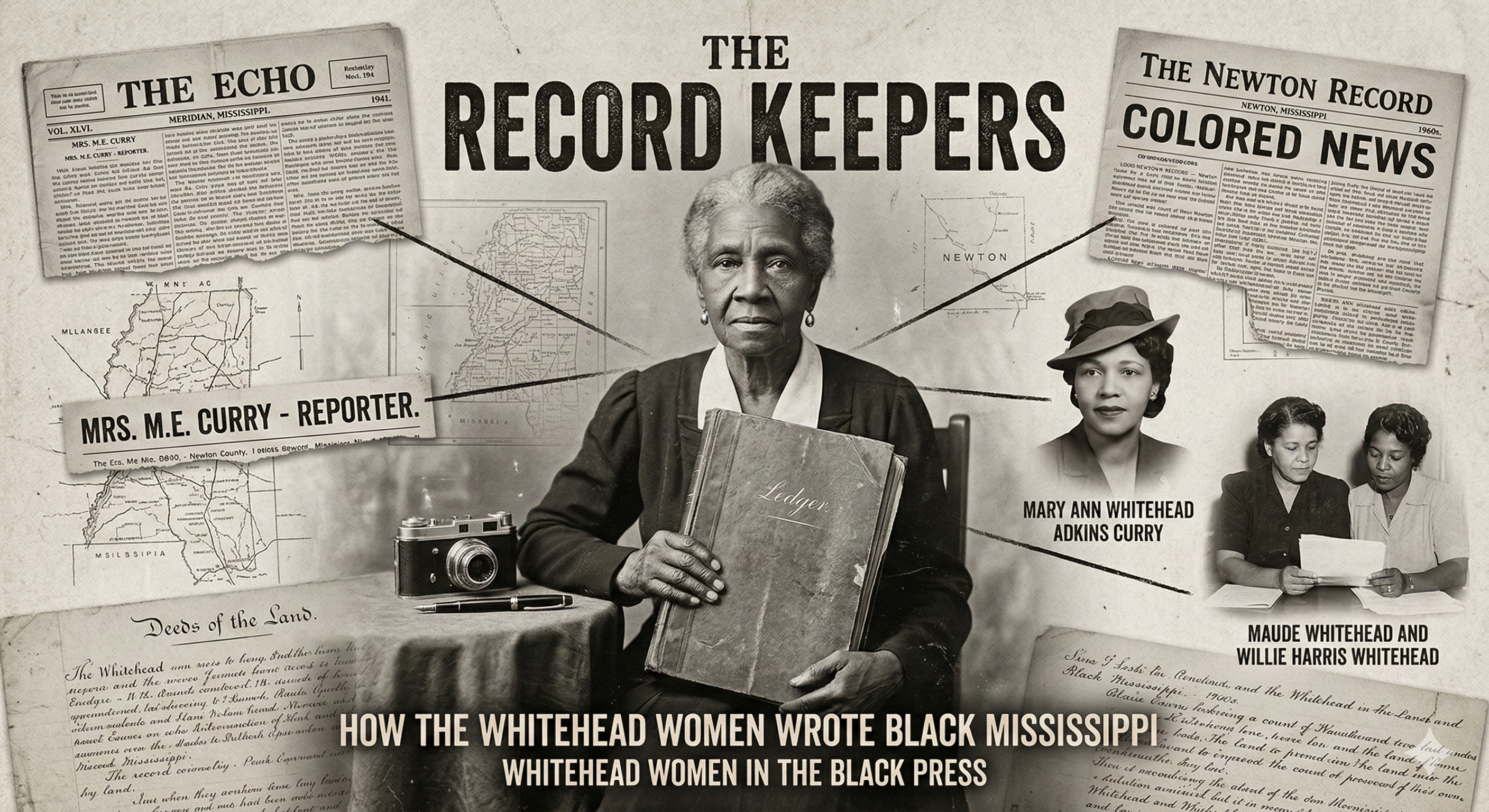
The history of journalism in Mississippi is often told through the towering names of male editors, national publishers, and fiery civil rights leaders. But in the red clay soil of Newton County, a quieter—yet equally radical—story unfolded.
It began in a Reconstruction-era Black landholding family whose women would become their community’s primary biographers across racial lines.
The Whitehead women did not just live history.
They recorded it.
The Foundation: Sena Nelson Whitehead
The Economic Engine of Literacy
The story begins with Sena Nelson Whitehead (c. 1853 – after 1930) — widow, landowner, employer.
Although the 1910 census lists her as unable to read or write, Sena accomplished something profoundly subversive in the Jim Crow South: she owned her farm outright, free of mortgage. At a time when a significant majority of Black farmers in Mississippi—approximately 56 percent—were ensnared in sharecropping or cycles of debt, Sena preserved her economic autonomy.
Her landownership created stability.
Her stability created literacy.
Her literacy-trained descendants created voice.
She raised her children in Beat 4 during the tightening grip of Jim Crow, yet she built what can only be described as a fortress of generational security.
The Generational Shift:
Sena secured the land.
Her descendants secured the voice.
Mary Ann Whitehead Adkins Curry
Reporter for The Echo (1941)
Sena’s eldest daughter, Mary Ann Whitehead Adkins Curry (c. 1872 – after June 1941), carried the family legacy from farmland to newsprint.
In June 1941, a clipping from The Echo — a Black newspaper founded in Meridian in 1895 — lists:
“Mrs. M. E. Curry — Reporter.”
By the 1940s, the Black press nationally reached nearly two million readers. It functioned as a parallel information system — documenting Black civic life, economic development, church leadership, and political awareness in ways white newspapers often ignored.
Mary Ann’s participation in The Echo places her inside that powerful media tradition.
For a woman born in the early 1870s — daughter of a mother who could not read — to become a community correspondent in her late 60s is extraordinary.
She moved:
From rural Newton County to the Delta.
From farmland to print.
From private matriarch to public recorder.
Maude Whitehead Denham (1893–1977)
The Gatekeeper of “Colored News”
The journalism tradition did not end with Mary Ann.
In the early 1960s, during the intensification of the Civil Rights Movement, Maude Whitehead Denham became one of the first Black reporters to contribute the “Colored News” column to the Newton Record. She was the daughter of Rev. Thomas M. Whitehead, who was the brother of Andrew Dowel Whitehead and the founder of Jerusalem M.B. Church in the community of Lawrence.
The title, “Colored News,” reflected segregation; however, the content subtly challenged it.
Within a white-owned paper that often-mentioned Black residents only in contexts of crime or conflict, Maude ensured that Black life appeared in full humanity.
She documented:
• The spiritual life of Black churches
• The dignity of funerals
• The joy of weddings
• Civic meetings and local achievements
She did not protest through headlines.
She preserved through documentation.
And preservation is power.
Willie Harris Whitehead
Generational Confidence in Voice
The story deepens further.
Willie Harris Whitehead, married to Maude’s brother Henry Mason Whitehead, also served as a reporter for the Newton Record alongside Maude.
Two women from the same extended Whitehead family reporting Black community life in a white newspaper during the height of Mississippi’s racial tension is not coincidence.
It is culture.
It is inherited literacy.
It is generational confidence in claiming space within the public record.
They were not merely writing news.
They were ensuring presence.
The Whitehead Generational Arc
| Era | Figure | Medium | Role |
|---|---|---|---|
| Reconstruction | Sena Nelson Whitehead | Land/Agriculture | Economic Foundation |
| Jim Crow | Mary Ann Curry | The Echo | Black Press Reporter |
| Civil Rights | Maude & Willie Whitehead | Newton Record | Community Documentarians |
Across three eras — Reconstruction, Jim Crow, and Civil Rights — Whitehead women transitioned from land security to media visibility.
Why This Matters: The Power of the Pen
Black newspapers like The Echo were instruments of survival and self-definition.
White newspapers like the Newton Record were segregated institutions — yet within those pages, Whitehead women carved out space for Black narratives.
They ensured that:
• Births were recorded
• Deaths were honored
• Illness and recovery were noted
• Migration and return were remembered
• Black dignity was printed
They functioned as unofficial census-takers of their own people.
Without them, much of rural Black Mississippi life would exist only in oral memory.
Because of them, it exists in ink.
The Legacy
These women did more than manage households.
They:
• Owned land
• Raised literate children
• Bridged segregated media spaces
• Participated in the Black press tradition
• Preserved their communities through print
They did not merely survive Mississippi history.
They authored the version of it we are still able to read.
And in doing so, they proved that sometimes the most radical act is not shouting.
It is writing.
Leave a Reply