In the late nineteenth and early twentieth centuries, education was the most subversive tool available to African Americans in Mississippi. For newly freed families, literacy was not simply an academic achievement—it was an act of resistance. It was about dignity, economic survival, and the ability to navigate a world designed to exclude them.
Yet education alone did not open every door. In the Jim Crow South, the professional world was rigidly divided along racial lines. Even those who achieved advanced schooling often found themselves excluded from many professions.
As a result, educated Black Mississippians were often channeled into a handful of vital roles. These professions—teacher, minister, midwife, undertaker, and skilled tradesman—became the backbone of Black institutional life in rural communities.
Education: The First Door to Opportunity
After the Civil War, education quickly became one of the highest priorities in African American communities. Schools were built through the efforts of local Black churches, supported in some cases by northern missionary societies and early Freedmen’s Bureau initiatives.
Though these “colored schools” were frequently underfunded and operated only a few months a year, they produced the first generation of literate Black Mississippians.
For many students who completed their schooling, the next step was clear: they became teachers themselves.
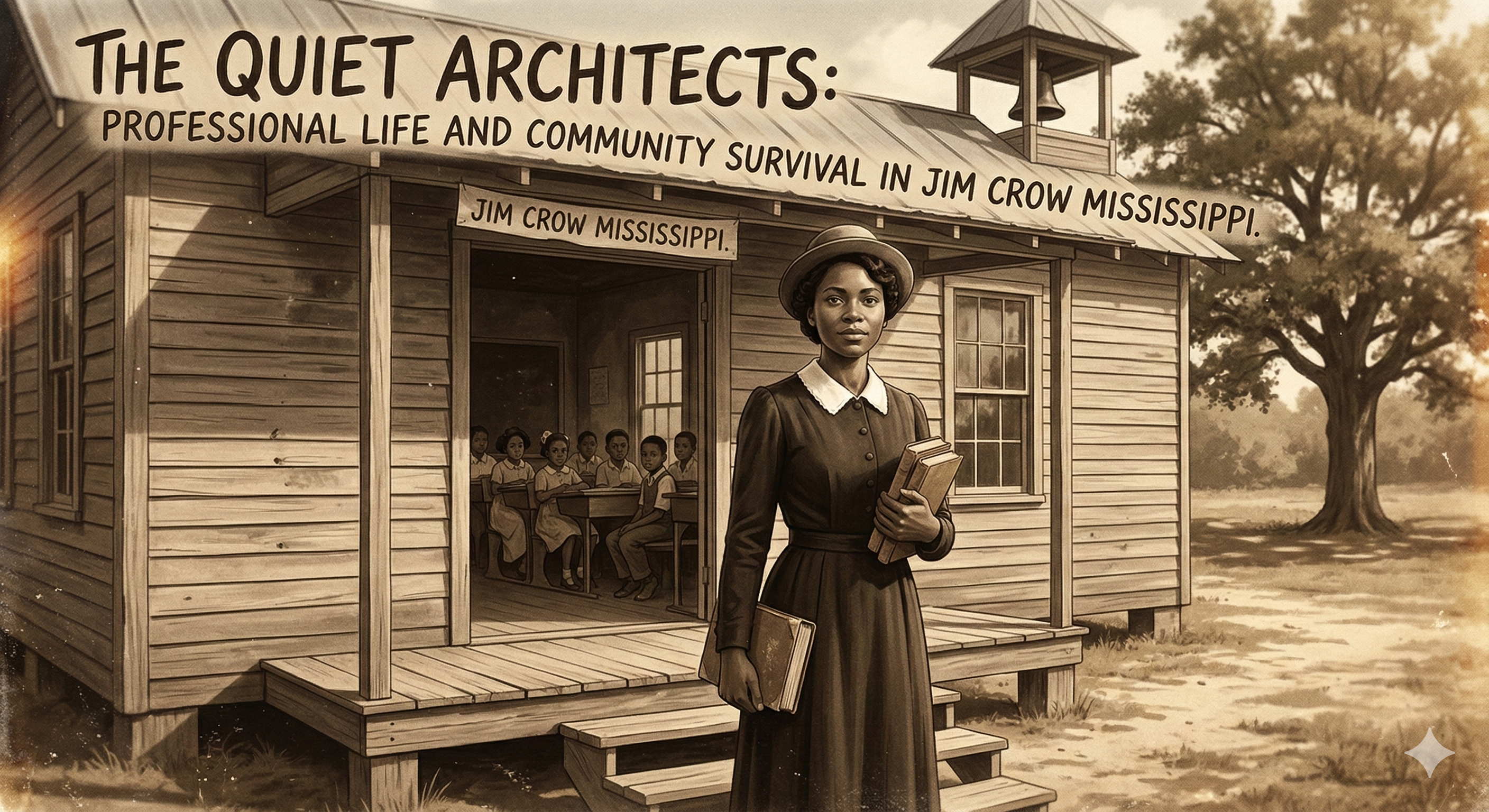
Teaching quickly became one of the most common professions among educated African Americans in rural Mississippi. Yet the role of a teacher extended far beyond the classroom. Teachers such as Della Billingsley Posey, who taught in rural Mississippi during the early twentieth century, served their communities in multiple ways.
They were often:
- Civilian Advocates, helping parents read legal papers or financial documents.
- Cultural Historians, preserving records and stories ignored by official institutions.
- Community Organizers, connecting the schoolhouse, the church, and the wider community.
In many places, the teacher was the most formally educated person in the community and therefore one of its most trusted leaders.
Pulpits and Healing: The Pillars of Leadership
While schools provided the tools of literacy, the church provided the platform for leadership.
For educated Black men, the ministry was one of the few professions that offered autonomy, authority, and influence. Ministers often served as the primary intermediaries between the community and the outside world. They organized congregations, helped resolve disputes, and frequently advocated for education and social improvement.
Alongside the spiritual leadership of the church stood another essential profession: health care.
In rural Mississippi, where white hospitals often refused Black patients, trained Black midwives and nurses became the primary medical providers in many communities. These women combined formal instruction with traditional knowledge passed down through generations.
They ensured that children were born safely and that families received care in a system that otherwise denied them access to medical services. In this way, they became the quiet medical architects of their towns.
Enterprising Dignity: Funeral Service and Skilled Trades
Another important profession within Black communities was funeral directing.
Because segregation extended even into death, Black undertakers established independent funeral homes that served African American families with dignity and professionalism. Funeral homes became more than businesses; they were community institutions where families gathered during times of grief and remembrance.
Funeral directors were often among the most respected figures in their towns because they combined entrepreneurship with compassion and service.
Similarly, literacy allowed many African Americans to succeed in skilled trades and small businesses. Barbers, tailors, carpenters, mechanics, black owned stores, and shopkeepers used their education to manage accounts, maintain records, and operate independent enterprises.
These businesses frequently served as informal community centers where neighbors gathered, exchanged news, and discussed local concerns.
The Burden of the Closed Door
The concentration of educated Black professionals in these fields was not simply a matter of preference. It was the result of systemic exclusion.
Many professions—including law, engineering, banking, and corporate management—remained largely closed to African Americans during the Jim Crow era. Even individuals with advanced schooling encountered major barriers.
These included:
- Limited educational programs, as segregated colleges often lacked professional graduate tracks.
- Professional isolation, with Black professionals excluded from white licensing boards and trade unions.
- Physical risk, since success in fields dominated by whites could provoke intimidation or violence.
Under these conditions, many educated individuals focused their talents on professions that served their communities directly.
Education as a Community Investment
In many Black families, education was never seen as a purely personal accomplishment.
If one person learned to read, teach, or manage accounts, they became the resource for an entire neighborhood. Knowledge was shared with siblings, cousins, and neighbors.
This is why family histories across Mississippi often reveal patterns in which multiple relatives entered similar professions—especially teaching, ministry, or community service.
Education was not simply a path upward for individuals. It was an investment in the stability and advancement of the community as a whole.
The Quiet Architects of Progress
The teachers, ministers, nurses, undertakers, and tradespeople of rural Mississippi rarely appear in national histories. Yet their work sustained communities during some of the most difficult decades of the American South.
Through classrooms, pulpits, and small businesses, they built institutions that allowed families to survive and grow.
Many of the students educated in these rural schoolhouses would later carry their skills north during the Great Migration, becoming workers, organizers, and leaders in cities such as Chicago, Detroit, and Gary.
The transformation of the twentieth century did not begin in large cities alone. It also began in small rural communities, where educated men and women quietly built networks of support, knowledge, and opportunity.
They were the quiet architects of progress, constructing a parallel society rooted in education, faith, and service—one that sustained generations and helped lay the foundation for the Civil Rights Movement that would follow.
They were the quiet architects of progress, constructing a parallel society rooted in education, faith, and service—one that sustained generations and helped lay the foundation for the Civil Rights Movement that would follow.
Their names may not appear in textbooks, but their influence lives on in family histories across the South.
Who were your Quiet Architects?
History is often written in the names of the famous, but progress was built in the quiet of rural Mississippi schoolhouses and church pews.
Do you have a teacher, a midwife, or a minister in your family tree who served their community during the Jim Crow era?
Leave a Reply