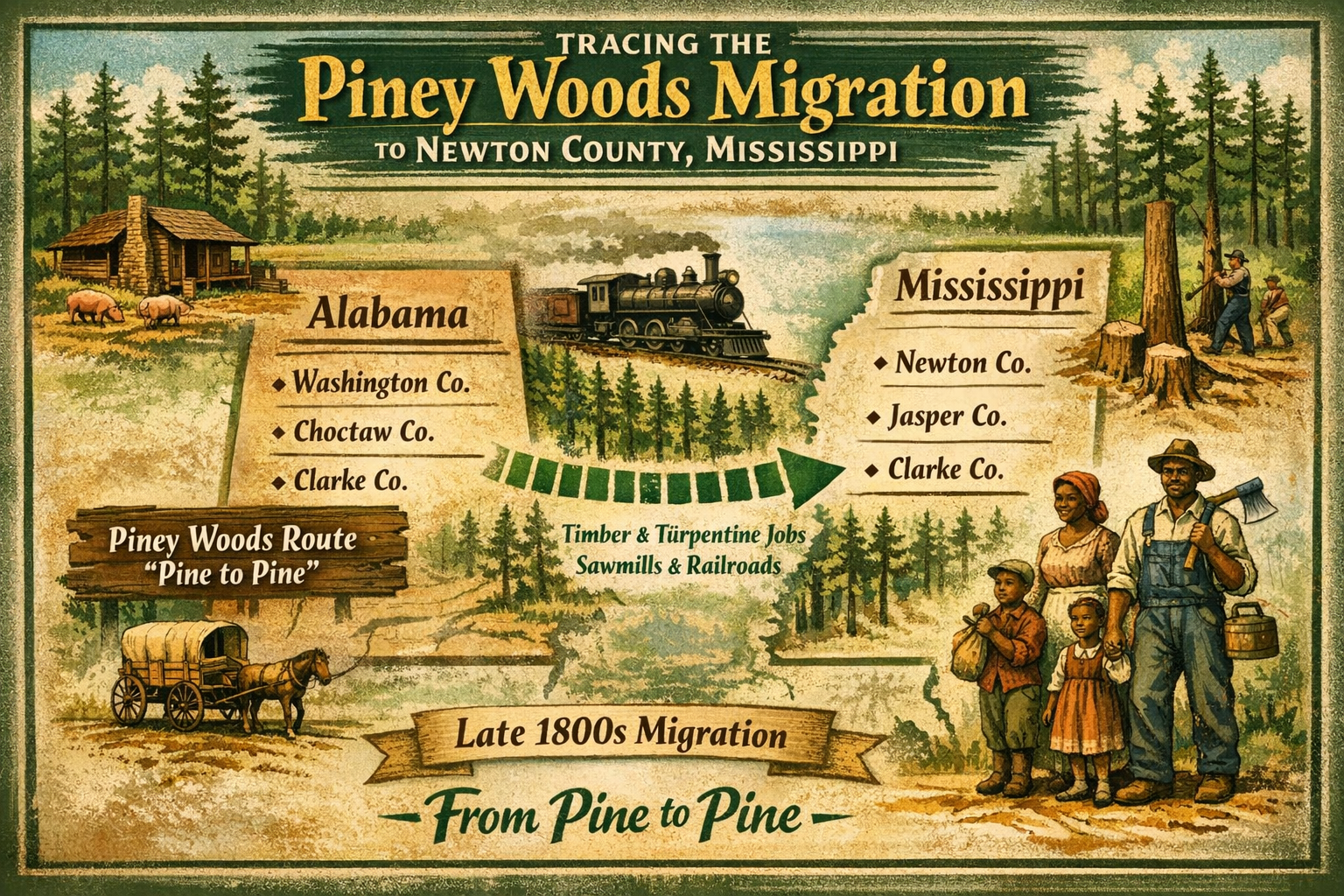
For many family historians tracing their roots into Newton County, Mississippi, the trail naturally points eastward toward Alabama. Most researchers gravitate toward the famous Black Belt—the crescent of rich, dark soil that defined the South’s massive cotton plantations.
But if your ancestors weren’t wealthy planters or enslaved on a 1,000-acre estate, you might be looking in the wrong part of the map. Many of the families who later settled in Newton County came through this Piney Woods corridor.
There was a second, often overlooked highway into Eastern Mississippi: The Piney Woods Route. Understanding this “Pine to Pine” migration is often the key to breaking through a 19th-century brick wall.
Two Different Worlds: The Black Belt vs. The Piney Woods
To find your ancestors, you have to understand the dirt they farmed. In the mid-1800s, Southern migration was rarely random; it was driven by environmental familiarity. * The Black Belt: Known for heavy, lime-rich soil, this region was the heart of the “King Cotton” aristocracy. It was dominated by large-scale plantations and a massive enslaved population.
- The Piney Woods: South of the Black Belt lay a landscape of rolling hills, sandy soil, and towering longleaf pines. Because this land was less “productive” for large-scale cotton cultivation, it became the domain of the yeoman farmer.
Instead of sprawling mansions, the Piney Woods economy was built on:
- Small-scale subsistence farming (corn, sweet potatoes, and garden crops).
- Open-range livestock (hogs and cattle).
- The “Naval Stores” industry (harvesting turpentine and timber).
The “Pine to Pine” Migration Pattern
Farmers accustomed to the sandy, wooded terrain of southern Alabama didn’t want the heavy, difficult-to-plow clay of the Black Belt. They sought land that looked like home.
As families moved westward, they hopped from one pine forest to the next, creating a corridor of migration through these key Alabama counties:
- Washington County
- Choctaw County
- Clarke County
If your family appears in Newton, Jasper, or Clarke County, Mississippi, by 1870, check the 1850 or 1860 census records in these Alabama “stepping stone” counties. You will often find the same surnames living as neighbors in both places.
African American Roots in the Timber Belt
For African American researchers, the Piney Woods route offers a distinct narrative. While many were brought into the region through the domestic slave trade to work on smaller farms and timber operations, a significant shift occurred after the Civil War.
The rise of the timber and turpentine camps and naval stores operations created a unique mobile labor force. After Emancipation, many Black families moved between Alabama and Mississippi to follow work in:
- Sawmills and Logging Camps: Often located in remote areas, these communities formed their own social hubs.
- Turpentine Camps: A grueling industry that spanned the entire Gulf South.
- The Railroads: Many families moved westward as the Vicksburg and Meridian Railroad began cutting through the pine forests of Newton County in the late nineteenth century.
Genealogy Tip: Look for “Industrial Schedules” in the U.S. Census or records of the African Methodist Episcopal (AME) or Baptist church associations, which often linked these timber-town congregations across state lines.
Why This Matters for Your Research
If you’ve been searching Greene or Sumter County, Alabama, with no luck, it’s time to shift your gaze south. The “Piney Woods” migrants lived a different lifestyle than their Black Belt neighbors. They were more likely to be:
- Mobile: Following timber jobs or new land openings.
- Interconnected: Marrying within the same small groups of “Piney Woods” families for generations.
- Non-Planters: Their records may be found in land patents and marks/brands for livestock rather than large plantation ledgers.
Following the Trail Backward
The history of Newton County is a tapestry woven from two different Alabamas. Whether your ancestors came from the white-pillared estates of the Black Belt or the rugged, turpentine-scented camps of the Piney Woods, their story is etched into the landscape.
To find them, stop looking at the state line—and start looking at the trees.
Black Belt vs Piney Woods Migration
| Feature | Black Belt | Piney Woods |
|---|---|---|
| Soil | Rich prairie | Sandy pine soil |
| Economy | Cotton plantations | Small farms, timber |
| Alabama counties | Greene, Sumter, Pickens | Washington, Choctaw, Clarke |
| Mississippi destinations | Lowndes, Noxubee, Clay | Jasper, Newton, Clarke |
Leave a Reply