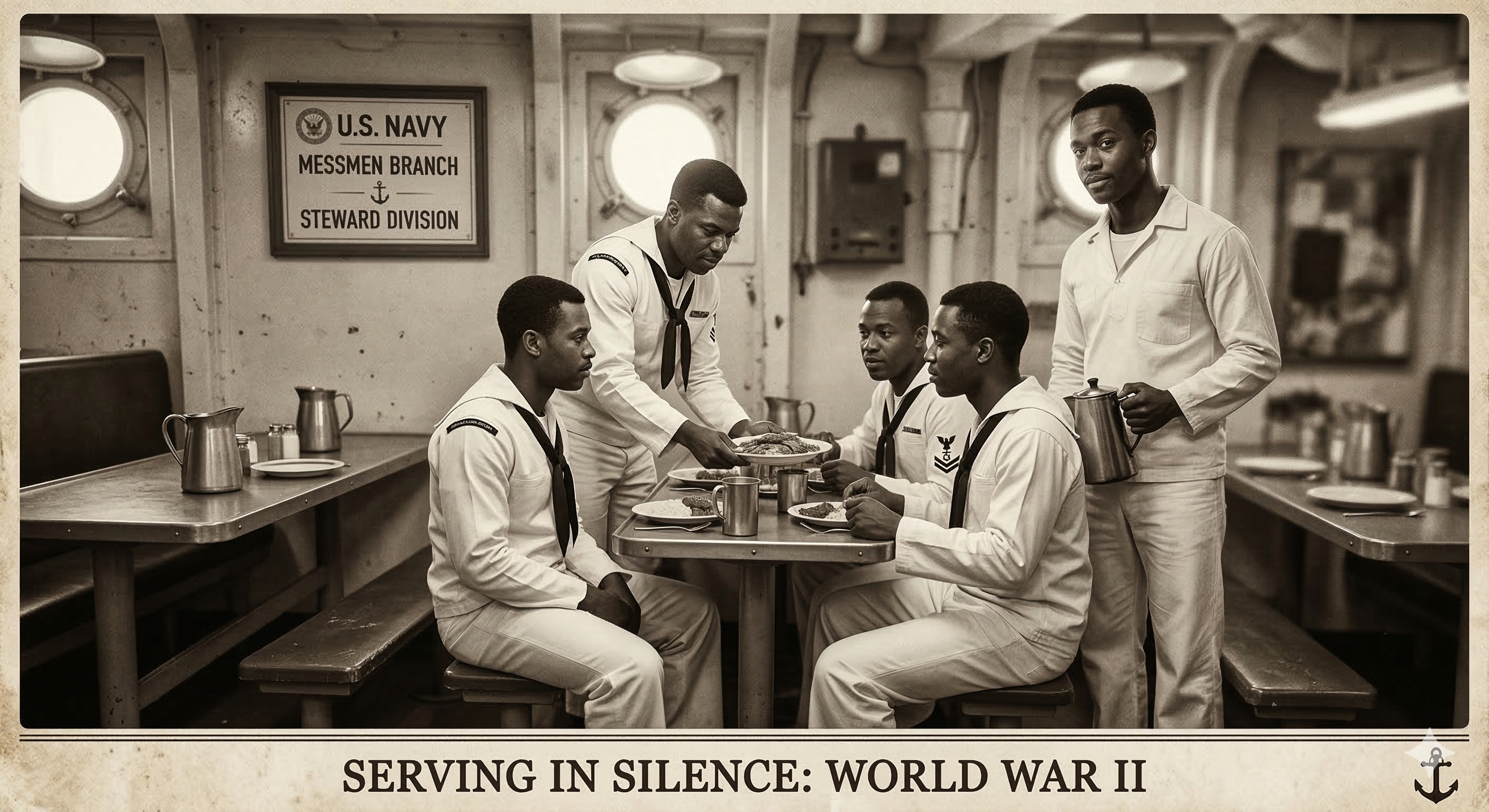
For many African American families across the rural South, military service during World War II represented both an opportunity and a contradiction. Young men left places like Newton County, Mississippi, hoping to serve their country, see the world, and build better futures. Yet when they entered the United States Navy, they stepped into a system that still enforced racial segregation. Their service—often carried out in the little-known Steward Branch—became part of a larger story about courage, inequality, and the long struggle for recognition and veterans’ benefits after the war.
Answering the Call in a Segregated Navy
During World War II, thousands of African American men answered the call to serve their country. They left farms, small towns, and cities across the South—including communities like Newton County, Mississippi—to join the United States military during one of the most defining conflicts of the twentieth century.
Yet their patriotism was met with a stark reality: the United States Armed Forces were still segregated.
Before 1948, African American servicemen were largely restricted to limited roles within the Navy. While they wore the same uniform and faced many of the same dangers as other sailors, opportunities for advancement and specialized training were tightly controlled by racial policies.
For most Black sailors, service meant entering a specific occupational division known as the Steward Branch.
The Steward Branch: Service Within Service
The Steward Branch was a division of the U.S. Navy responsible for hospitality and personal service duties aboard ships and naval installations. Men assigned to this branch were trained in roles that supported the daily functioning of officers and ship operations.
Typical duties included:
- Preparing and serving meals for officers
- Managing dining areas known as the officers’ mess
- Maintaining officers’ quarters
- Laundry and housekeeping services
- General hospitality and steward operations aboard naval vessels
These responsibilities were essential to naval life. Ships at sea depended on organized food service, clean living quarters, and logistical support to maintain morale and efficiency.
However, the Steward Branch also reflected the racial restrictions of the era. While white sailors could pursue technical specialties, combat roles, and command positions, Black sailors were often limited to steward duties regardless of their education or abilities.
Despite these limitations, many African American sailors built long and distinguished careers in the Navy, serving with professionalism and discipline even within a system that denied them equal opportunity.
The Path Toward Military Integration
The experience of Black servicemen during World War II helped expose the contradictions of fighting for democracy abroad while segregation persisted at home.
Pressure from civil rights leaders, veterans, and activists eventually led to a major turning point. In 1948, President Harry S. Truman issued Executive Order 9981, ordering the desegregation of the United States Armed Forces.
This decision marked the beginning of the end of racially restricted roles like the Steward Branch which persisted in name until 1974, when it was finally merged into the “Mess Management Specialist” rating. The racial exclusivity ended in the 50s, but the legacy of the branch was long-lasting; however, over time, African American sailors gained access to all naval occupations, including technical fields, aviation, and combat positions.
But for many veterans who had served during the segregated era, the challenges did not end when their military service concluded.
The Struggle for Veterans’ Disability Benefits
After returning home, African American veterans often faced significant obstacles when applying for disability benefits through the Veterans Administration (VA).
Disability benefits were intended to support veterans whose health had been affected by their military service. In practice, however, Black veterans frequently encountered barriers that made receiving these benefits difficult.
Some of the most common challenges included:
Limited Medical Documentation
Many Black servicemen received inadequate medical evaluations during service, making it difficult to prove service-related injuries later.
Discriminatory Review Practices
Local VA offices in the South often reflected the racial attitudes of the era. Claims filed by African American veterans were sometimes dismissed or delayed without thorough review.
Restricted Access to Medical Care
Black veterans had fewer hospitals available to them because of segregation, making it harder to obtain the medical records needed to support disability claims.
Long Appeals Processes
Even when claims were eventually approved, the process could take years, leaving many veterans without support during critical periods of their lives.
As a result, many African American veterans who had served honorably returned home to a system that did not fully recognize their sacrifices.
The “Blue Discharge”: A Hidden Barrier for Black Veterans
Another obstacle faced by many African American servicemen during and after World War II was the controversial “Blue Discharge.”
Between 1941 and 1945, the military issued thousands of these administrative discharges, formally known as “blue tickets.” The document itself was printed on blue paper and represented a status that was neither honorable nor dishonorable.
In practice, however, the Blue Discharge carried serious consequences.
While officially intended for minor infractions or administrative separations, historical studies show that African American servicemen received Blue Discharges at disproportionately high rates, particularly in the Navy and Marine Corps.
Unlike an Honorable Discharge, a Blue Discharge often left veterans in a gray area. Many employers viewed it negatively, and veterans who received it frequently struggled to access the benefits promised under the GI Bill.
These benefits included:
- Access to Veterans Administration medical care
- Eligibility for education funding
- Home loans and housing assistance
- In many cases, disability compensation
Because the Blue Discharge was neither fully honorable nor officially punitive, it effectively created a barrier between thousands of Black veterans and the benefits they had earned through military service.
Public criticism of the policy grew after the war, and by 1947 the military abolished the Blue Discharge system. By then, however, many veterans had already lost access to opportunities that helped shape the postwar American middle class.
A Legacy of Service and Perseverance
Despite these obstacles, African American servicemen of the World War II era left an enduring legacy.
Their service in branches like the Navy Steward Division demonstrated professionalism and commitment under conditions of inequality. Their experiences also helped fuel the broader civil rights movement, as many veterans returned home determined to demand the freedoms they had defended overseas.
Today, historians and descendants are increasingly recognizing the contributions of these men—farm boys from Mississippi, factory workers from northern cities, and sailors who crossed oceans while serving in a segregated military.
Their stories remind us that the fight for equality did not end on the battlefield.
In many ways, it was only beginning.
Leave a Reply