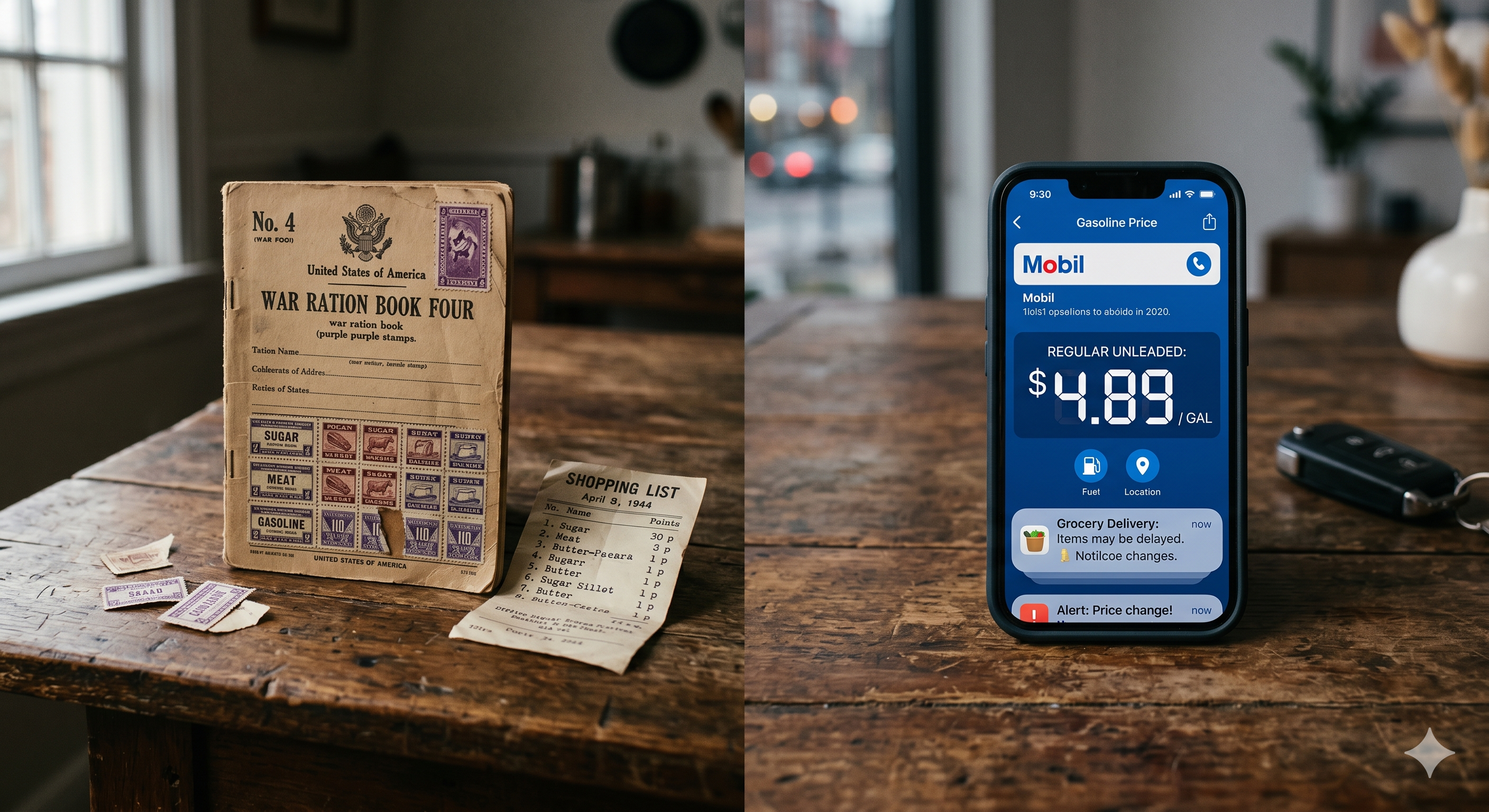
In moments of global uncertainty, history has a way of rising to the surface. With shifting tensions in the Middle East, fluctuating prices at the gas pump, and fragile supply chains, a familiar question is resurfacing in American households:
Are we heading back to rationing?
To answer this honestly, we have to look past the headlines and understand that rationing in the 1940s wasn’t just a “shortage”—it was a fundamental shift in how human beings interacted with the economy.
The 1940s: Structured Scarcity
Rationing during World War II was not simply about rising prices; it was about government-mandated access. Money alone was no longer the primary currency of the United States.
A ration book determined the rhythm of your life:
- The Weekly Menu: Whether your family could have meat on Tuesday or if you had to settle for “Victory Loaf.”
- The Commute: Whether you had enough “A” stickers for your windshield to drive to work.
- The Wardrobe: How many pairs of shoes your children could own in a year.
It wasn’t an inconvenience; it was structured scarcity. Losing a ration book didn’t mean you had to pay more—it meant you were effectively locked out of the food supply until the government replaced your papers.
Why Today is Fundamentally Different
Despite the very real stress of modern grocery bills, the United States is not currently facing the conditions of 1942. Here is why:
1. A Consumer Economy vs. A War Economy In the 1940s, the “Arsenal of Democracy” required total conversion. If a factory could make a toaster, it was told to make a landmine instead. Today, our economy remains overwhelmingly focused on civilian goods. We are seeing “bottlenecks,” not a total diversion of resources to the front lines.
2. The Global Safety Valve Unlike the 1940s, today’s supply chain is a massive, interconnected web. If one oil refinery closes, another halfway across the world can often compensate. This global flexibility usually results in higher prices (inflation) rather than empty shelves (absolute shortage).
3. The “Private” Rationing of Today In the 1940s, the government set the limits. Today, we see “soft rationing” by retailers. Think back to 2020: stores limited you to two packs of eggs or one bundle of paper towels. This is a local response to panic buying, not a federal mandate for survival.
The “Affordability” Gap: A Different Kind of Rationing
The most important distinction to remember is this:
- Today: The question is usually, “Can I afford this?”
- The 1940s: The question was, “Am I allowed to buy this?”
When prices rise, the market “rations” goods to those who can pay the most. While this is painful and unfair, it is a different mechanism than the 1940s, where even a millionaire couldn’t buy an extra pound of sugar without the proper stamp.
The Hidden Lesson: Inequality Rhymes
While the system of rationing may not return, the experience of crisis remains uneven. Just as Black families in Newton County or Hattiesburg faced deeper hurdles in the 1940s due to segregation and lower wages, today’s economic shifts hit vulnerable communities first.
Rising gas prices aren’t just a nuisance for someone working three jobs; they are a barrier to survival. When the “cost of living” rises, those at the bottom are effectively “rationed” out of the market by price alone.
When Would “True” Rationing Return?
For the government to reissue ration books, we would need to see a “Black Swan” event:
- A direct, large-scale kinetic war involving major powers.
- A total collapse of the global shipping and credit systems.
- Domestic agricultural failure on a national scale.
We are currently far from those markers.
Closing Reflection
Understanding rationing helps us put our current frustrations in context. We are living through a period of economic stress, but we are not yet in a period of controlled survival.
The lesson of the 1940s isn’t just about stamps and sugar—it’s about the strength of the community. Whether the scarcity is caused by a government stamp or a high price tag, the answer remains the same: we endure by looking out for our neighbors and recognizing that stability is a gift, never a guarantee.
Leave a Reply