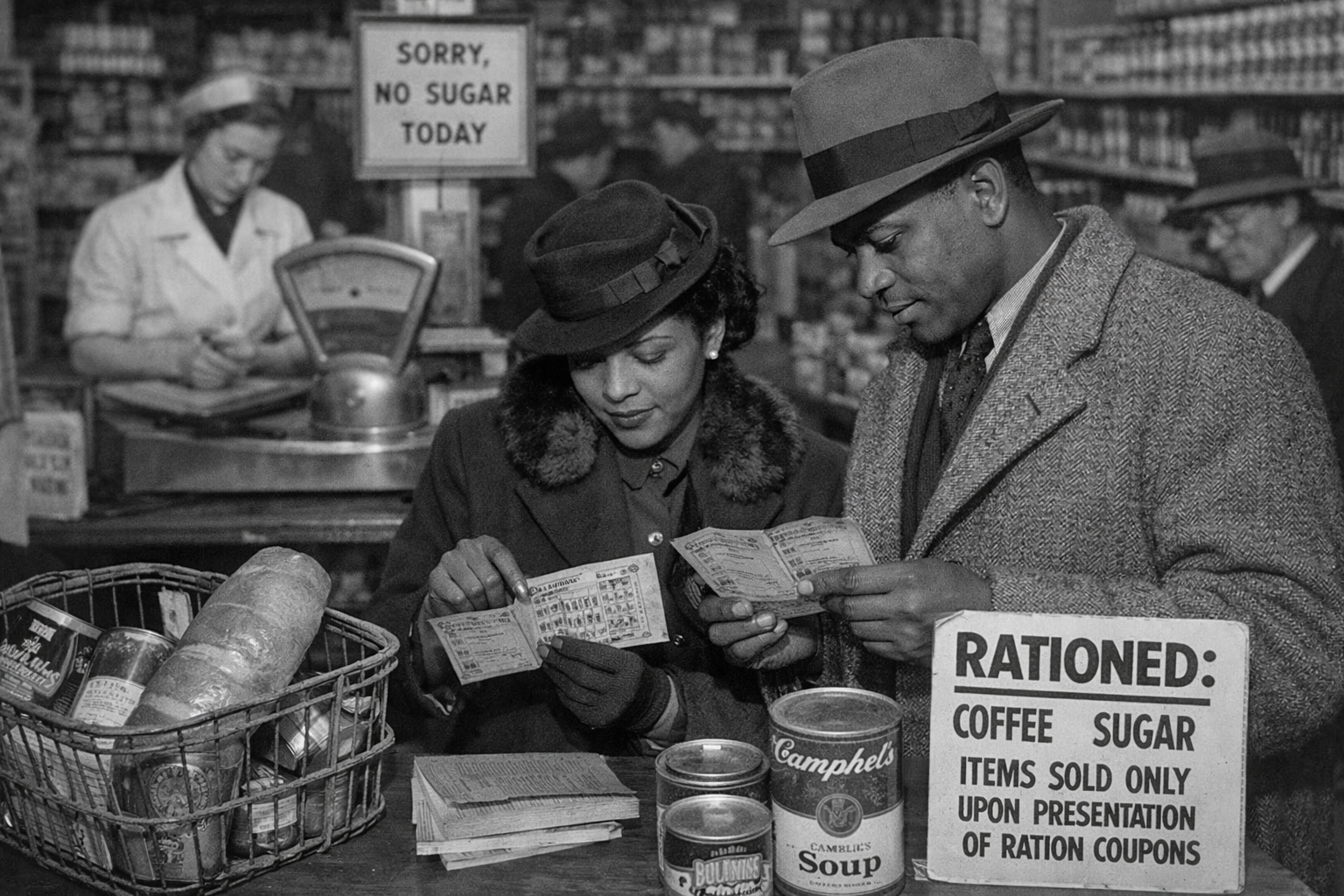
During World War II, survival on the home front required more than just hard work—it required a level of discipline that lived in the palm of your hand. It came in the form of a small, paper booklet that dictated exactly what you could eat, wear, and drive.
That booklet was the ration book, and in the 1940s, it was more valuable than the cash in your wallet.
What Was a Ration Book?
A ration book was a government-issued collection of stamps and coupons. While we think of shopping today as a matter of “can I afford this?”, wartime shopping was a matter of “do I have permission?”
Without the correct stamp, you couldn’t walk away with essentials—regardless of how much money you offered the clerk. These booklets controlled the flow of:
- Kitchen Staples: Sugar, coffee, butter, meat, and cooking fats
- Daily Essentials: Shoes, fuel oil, and gasoline
Once a stamp was torn out and exchanged, it was gone. There were no “refills” until the next issuance, making every meal a calculated decision.
Why Scarcity Became Law
By early 1942, after the United States entered World War II, the nation became the “Arsenal of Democracy.” Factories that once built sedans now produced B-24 Liberators. This shift meant that raw materials—rubber, tin, nylon, and even food—were diverted to the war effort.
Rationing wasn’t just about shortage; it was a deliberate national strategy to:
- Ensure Fairness: Prevent the wealthy from buying up the entire supply
- Limit Hoarding: Reduce panic buying and black market activity
- Prioritize the Front: Ensure soldiers overseas had what they needed
The Reality of the “Kitchen Front”
Every person in a household—from infants to the elderly—received their own ration book. This turned everyday life into a careful balancing act. Families had to track not just stamps, but “points”—red for meat and dairy, blue for processed foods—turning every grocery trip into a complex math problem.
Women, in particular, became the managers of scarcity—stretching ingredients, substituting items, and planning meals around available stamps. Butter became oleomargarine. Coffee was stretched with chicory. Nothing was wasted.
In places like Newton County and Hattiesburg, Mississippi, rationing shaped not just what families ate, but the rhythm of daily life—what could be cooked, worn, or saved for Sunday. The stakes were incredibly high. If a family lost their “Book No. 4,” it wasn’t a minor inconvenience—it was a crisis. It meant the temporary loss of the ability to purchase basic necessities like meat, sugar, or shoes.
The Hidden Burden: Inequality in the Lines
For Black families in the Jim Crow South, rationing came with an added layer of difficulty rooted in deep inequality. While rationing was presented as a system of shared sacrifice, access was rarely equal:
- Limited Access: Many Black families were restricted to certain stores, often the last to be restocked.
- Economic Barriers: Even with stamps, lower wages made purchases more difficult.
- Uneven Opportunity: Planning ahead was a luxury many couldn’t afford on segregated wages.
Yet, in the face of these challenges, Black communities relied on long-standing traditions of mutual support—sharing garden produce, trading eggs, and helping neighbors survive. It was, in many ways, survival through community.
More Than Paper: A Symbol of Patriotism
Today, ration books may appear as simple artifacts, but during the 1940s, they represented something far greater. They were symbols of:
- Discipline in the face of scarcity
- Shared sacrifice across households
- Participation in a national effort, even from home
They reflected a country that asked its citizens to live with less so that others—especially those on the front lines—might have enough.
Looking Closer at the Record
When you encounter a historical record that reads: “Lost Ration Book,” look closer. You are not simply seeing paperwork—you are seeing lived experience:
- A mother counting stamps and “points” by lamplight
- A family weighing whether to use their last meat coupon
- A household navigating uncertainty one meal at a time
These are the quiet stories that rarely make headlines but define an era.
Closing Reflection
The ration book reminds us that history is not only written by generals or politicians—it is lived in kitchens, grocery lines, and family tables. It stands as a testament to the quiet strength of ordinary people who learned to live with less so that others might have enough.
Leave a Reply