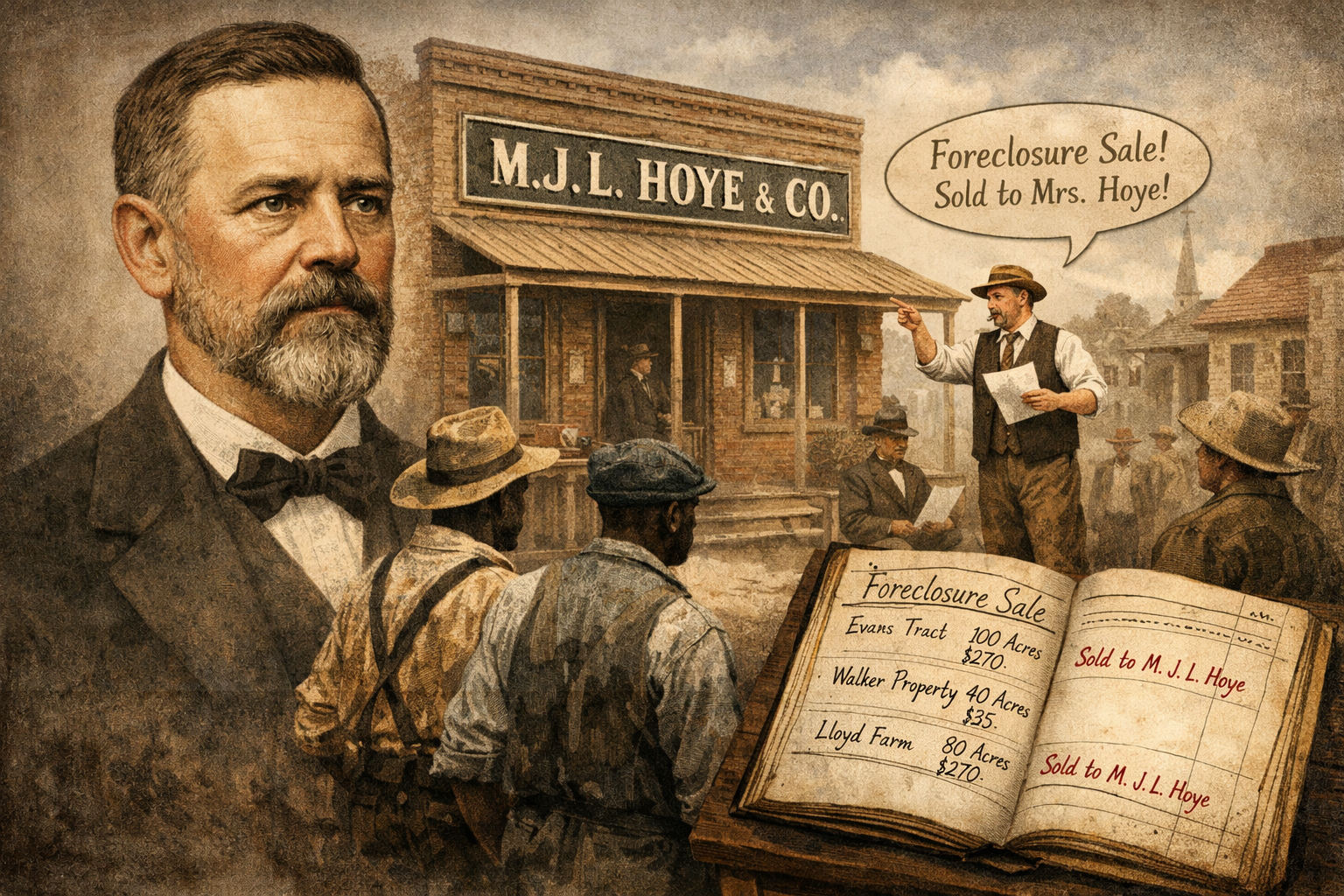
For generations, the “Yesterday in Newton” columns have preserved a familiar story about Matthew John Lucas Hoye. In these accounts, he appears as a “pioneer,” a “founding father,” and a man whose estate was among the largest to pass through the courts after the Civil War. He is remembered as a successful country schoolteacher and a merchant who built his fortune through “honest dealing.”
But when we move beyond memory and into the archival record—layering census data, land deeds, tax rolls, and mortgage books—a more complicated picture emerges. The image of the self-made merchant begins to fracture. In its place stands a man deeply embedded in a system that reshaped land ownership across Newton County in the decades after emancipation.
The Captain of the Old Guard
Long before he was a merchant, Hoye was a soldier of the Confederacy. Enlisting as a young man, he rose to the rank of captain in the 39th Mississippi Infantry and participated in campaigns such as the Siege of Port Hudson—a battle fought to preserve a slaveholding society.
When the war ended, that world collapsed. Like many former Confederates, Hoye returned home to a radically altered economy. The 1870 census records him modestly—as a clerk with limited real estate holdings. By all outward appearances, he had been reduced to the same instability that defined the postwar South.
But Hoye possessed two advantages that many newly freed families did not: literacy in the law and access to established networks of power. In a world where freedom had been declared but resources had not been redistributed, those advantages proved decisive.
The Architecture of a County-Wide System
In the decades following the Civil War, the Southern economy reorganized itself around the crop-lien system. This system allowed merchants to extend credit to farmers—providing seed, tools, and food in exchange for a claim on future crops. When crops failed or prices fell, debts accumulated. Increasingly, those debts became secured not just by crops, but by the land itself.
This process was often formalized through a Deed of Trust—a legal instrument that allowed creditors to seize and sell land through a trustee if a borrower defaulted.
From the mid-1870s until his death in 1890, M.J.L. Hoye emerged as one of the most powerful local operators within this system in Newton County. His store was more than a place of commerce; it functioned as a financial hub in a region where formal banking was largely inaccessible. For Black families emerging from slavery, as well as for many poor white farmers, merchants like Hoye represented the primary source of credit.
But credit came with terms. Deed books and mortgage records from the period reveal a consistent, clinical pattern:
- Goods extended on credit
- Debt carried forward across seasons
- Land pledged as collateral through a Deed of Trust
- Property transferred upon default via public auction
Across Newton County—from Decatur to Lawrence—parcels of land began to move. Small holdings that had briefly come into the possession of freedmen and struggling farmers were gradually consolidated into larger estates through the machinery of foreclosure.
The Evidence in the Ledger
The archival record provides a window into exactly how this happened. Newton County Chancery Court records from the 1890s show the Hoye estate—represented by his widow, Bettie Hoye—systematically collecting on debts through public auctions held “at the door of the storehouse of Mrs. M.J.L. Hoye.”
The Evans Foreclosure (March 1894):
Chancery records show that Pleas Evans and Pleas Evans Jr. had entered into a debt in 1892. When they defaulted, Trustee T.R. Loper sold their 100-acre tract in Section 27 at public outcry. The high bidder was Mrs. Bettie Hoye, who reclaimed the land for the estate for $270.
The Walker Foreclosure (March 1894):
In the same wave of sales, Willis Walker and his wife Harriet lost their holdings in Section 24. Their 40-acre plot was struck off and deeded to Mrs. Bettie Hoye for just $35.
The Moore Foreclosure (January 1905): Years later, the pattern repeated with George Moore and his wife Matilda. Their land in Section 27 was auctioned off by Trustee C.H. Doolittle to satisfy a debt owed to “M.J.L. Hoye’s son.” C.R. Hoye purchased the 20-acre tract for $75.
These were not isolated incidents. They were part of a patterned process—one that converted debt into land and land into consolidated wealth.
A Geography of Loss
The story of Hoye’s success cannot be understood without examining its geographic impact. By the 1880s, census records show a clear contrast: Hoye is listed as a “merchant,” residing in relative comfort, while many of his neighbors are listed as “farm laborers,” often without land.
For families such as the Evanses, the Walkers, and the Moores—families who had established footholds in landownership in the fragile years following emancipation—this period marked a narrowing of opportunity.
The records show that the cycle of debt often spanned decades.
Tax rolls and deed transfers from the late nineteenth and early twentieth centuries suggest a steady movement of land away from small-scale farmers and into the hands of creditors. Families who had worked to establish independence—some only a generation removed from enslavement—found that independence increasingly difficult to sustain.
A Dynasty That Outlived Its Founder
When M.J.L. Hoye died in 1890, control of his estate passed to his wife, Bettie, and later to his sons, including C.R. and Albert Hoye. The business of extending credit, collecting debts, and acquiring land continued into the next generation.

The name at the top of the ledger changed, but the structure remained intact.
The foreclosure records of 1894 and 1905 demonstrate that the Hoye enterprise remained a mechanism of land transfer long after the Captain himself was gone. This continuity underscores a larger truth: the story is not simply about one man, but about a system that allowed wealth to accumulate in the hands of those who controlled credit, while those who depended on it bore the risk.
Beyond the Myth of the “Pioneer”
Today, the surviving buildings associated with Hoye’s enterprise—particularly those along West Church Street—are often viewed as symbols of progress. They stand as physical reminders of a growing town in the late nineteenth century.
But buildings tell only part of the story.
For the descendants of those who lost land during this period, those same structures can represent something else: the material outcome of an economic system that transferred property from many into the hands of a few.
Hoye’s obituary praised him as a “pioneer.” In one sense, that is true. He was a pioneer of a postwar economic order—one that replaced the plantation with the ledger, and physical coercion with the legal contract.
Reconsidering the Record
The goal of revisiting figures like M.J.L. Hoye is not to replace one myth with another, but to broaden the historical record.
He was not simply a villain, nor merely a self-made success. He was an effective participant in a system that reshaped Newton County during Reconstruction and beyond.
Understanding that system requires us to look beyond celebratory narratives and examine the mechanisms of power:
- Who had access to credit?
- Who controlled land transfers?
- Who bore the risk when crops failed?
When we do, the story of Newton County becomes more than a tale of individual achievement. It becomes a history of contested freedom—of gains made, and of ground lost.
In Newton County, the ledger did not just record history—it rewrote it.
Leave a Reply