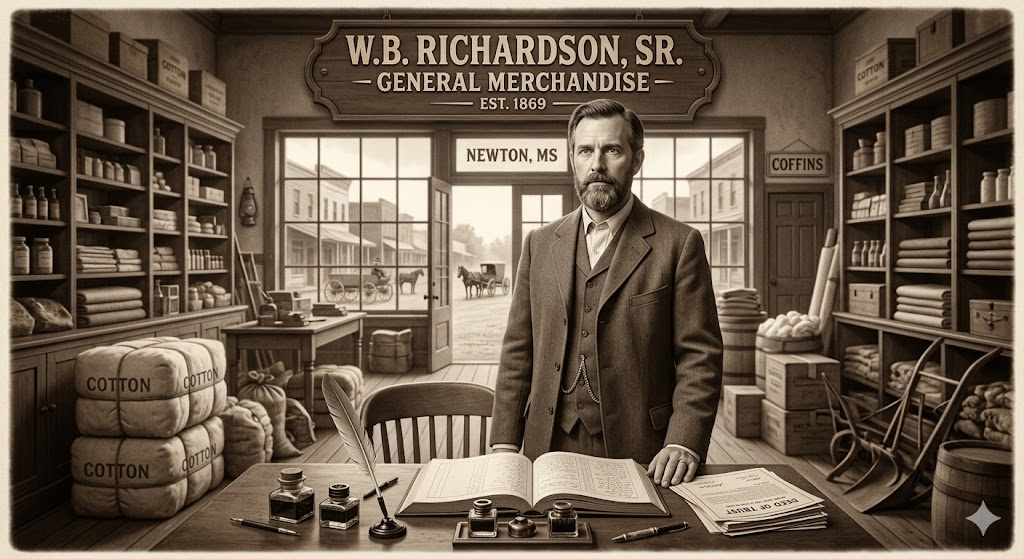
History has a way of softening the edges of power.
In the 1936 obituaries and the nostalgic “Yesterday in Newton” columns, William Benjamin Richardson, Sr. appears as the ideal Southern patriarch—a “democratic” merchant who rose from the ashes of the Civil War to build a commercial empire and ultimately became the political “Rex” of the county.
But when we move beyond memory and into the record—examining census data, deeds of trust, and foreclosure notices—a more complex and revealing portrait emerges. W.B. Richardson was not simply a merchant; he was a central figure in a financial system that both fueled Newton County’s growth and bound its farmers to cycles of debt.
The “Made Man” of Main Street
The legend presents Richardson as self-made. The record suggests otherwise.
Born in 1844 to a wealthy family in North Carolina and raised in Kentucky, Richardson entered Newton County in 1869 with a significant advantage: he was the nephew of Col. Edmund Richardson, widely known as the “Cotton King of the World.”
Rather than a struggling newcomer, he appears as a strategically positioned extension of a larger commercial network. By the 1890s, his business reportedly handled $150,000 annually. His brick “Supply House” on Main Street sold everything “from pins to coffins,” and his free campyard offered a place of rest for traveling farmers.
To the town, he was a benefactor.
To the farmers, he was something more consequential: a primary gateway to credit.
The Ledger of Risk: A “Careful” Creditor?
Comparisons are often made between Richardson and merchants like M. J. L. Hoye, particularly regarding who was the more “careful” lender.
If Hoye’s presence is visible through volume, Richardson’s influence was defined by scale and integration.
Operating on a charge system, Richardson frequently carried families on his books for multiple years. This created not only financial dependency, but social and economic entanglement. Yet this system was not informal—it was structured through the legal framework of the crop-lien system.
Deeds of trust tied to individuals such as Lawrence Rogers, Henry Cotton, and Nat Evans reveal the structure clearly. Credit was extended but always secured. Collateral typically included:
- The upcoming cotton crop
- Livestock and farming tools
- The land itself
For Richardson, risk was distributed across hundreds of accounts. When crops failed or debts accumulated, the legal instruments ensured recovery—through property, equipment, or land.
He was not necessarily more lenient than his counterparts. He was more deeply embedded.
The View from Foreclosure
From the perspective of the farmer, the system functioned differently.
Under the crop-lien structure, a single failed harvest did not end a debt—it extended it. Balances rolled forward, often compounded by interest and inflated supply costs. Over time, the gap between production and obligation widened.
When foreclosure occurred, it was not merely a financial adjustment. It represented the loss of land, tools, and in many cases, long-term family stability.
Properties associated with families such as Nat Evans and Henry Cotton eventually became part of Richardson’s expanding holdings, including tracts tied to the Tanglewood Plantation.
The Boll Weevil: The Collapse of a System
If Richardson held the advantage through collateral and contracts, why did his empire fall?
The answer lies in a force beyond the reach of any ledger: the boll weevil.
As infestations devastated cotton crops across successive seasons, the foundation of the entire credit system collapsed. Farmers could no longer produce. Without production, debts could not be repaid.
At the same time, the land itself—once valuable because of its cotton yield—lost its market value. Foreclosure no longer guaranteed recovery; it produced assets that could not be liquidated.
Richardson’s position was further strained by his obligations to wholesale suppliers in New Orleans and St. Louis. As local debts became uncollectible, his own financial commitments remained.
In 1914, the system that had elevated him unraveled. He lost his inventory, his business, and his residence on South Main Street—the same mechanisms of foreclosure turning back upon him.
The Verdict: Merchant or Mogul?
W.B. Richardson, Sr. was undeniably a prominent figure. He helped shape Newton County’s commercial landscape and stood at the center of its economic life.
But the record complicates the legacy.
He operated within—and benefited from—a system that leveraged debt as a tool of control and expansion. His success was not simply the result of individual effort, but of a structure that tied credit, land, and labor into a single cycle.
He was not a villain. He was not a saint.
He was a man who mastered the system of his time—
and, in the end, was undone by it.
Footnotes
- Birth and Heritage: 1850 U.S. Federal Census, Christian County, Kentucky, District
- Dwelling 217 (Household of James Richardson); 1910 U.S. Federal Census, Newton County, Mississippi, Beat 4, Sheet 19B.
- Kinship with the “Cotton King”: Nancy Williams, “Yesterday in Newton: W.B. Richardson,” The Newton Record, June 24, 1992. (Detailing the 1869 arrival to manage Col. Edmund Richardson’s interests).
- Commercial Scale: The Newton Record, May 13, 1992. (Citing 1891 annual business figures of $150,000 and “pins to coffins” inventory).
- The Charge System: A.J. Brown, History of Newton County, Mississippi from 1834 to 1894, as cited in The Newton Record, August 26, 1992.
- Legal Instruments of Debt: Newton County Deed of Trust Book 11, Page 326 (Watkins/Richardson, 1893); Deed of Trust Book 11, Page 609 (1894).
- Specific Collateralization: Deed of Trust Book 16, Pages 543-544 (Watkins/Richardson regarding Nat Evans, 1900). Records indicate security interests in “the entire crop of cotton and corn” plus livestock and land.
- Land Acquisition Patterns: Analysis of Township 5, Range 11 Land Deeds (Newton County, MS). These records track the transfer of acreage from individual farmers (including the Rogers and Cotton lineages) to the Richardson mercantile holdings via satisfaction of debt.
- Tanglewood Connection: The Newton Record, September 2, 1992. Reference to Richardson’s involvement in large-scale land tracts in Newton County.
- The Boll Weevil: The Collapse of a System: Impact of the Infestation: “Merchant W.B. Richardson Retires from Business,” The Newton Record, early 1915 retrospective; see also Obituary, The Newton Record, February 6, 1936.
- Bankruptcy and Liquidation: The Newton Record, August 26, 1992. Mentions the 1914 bankruptcy filing and the subsequent loss of the family residence at 413 South Main Street to satisfy creditors.
- Final Status: 1930 U.S. Federal Census, Newton County, Mississippi, Enumeration District 51-1, Page 2A. Richardson is listed at age 86 as “Retired,” living on Main Street with his home value significantly depreciated to $3,500.
Leave a Reply