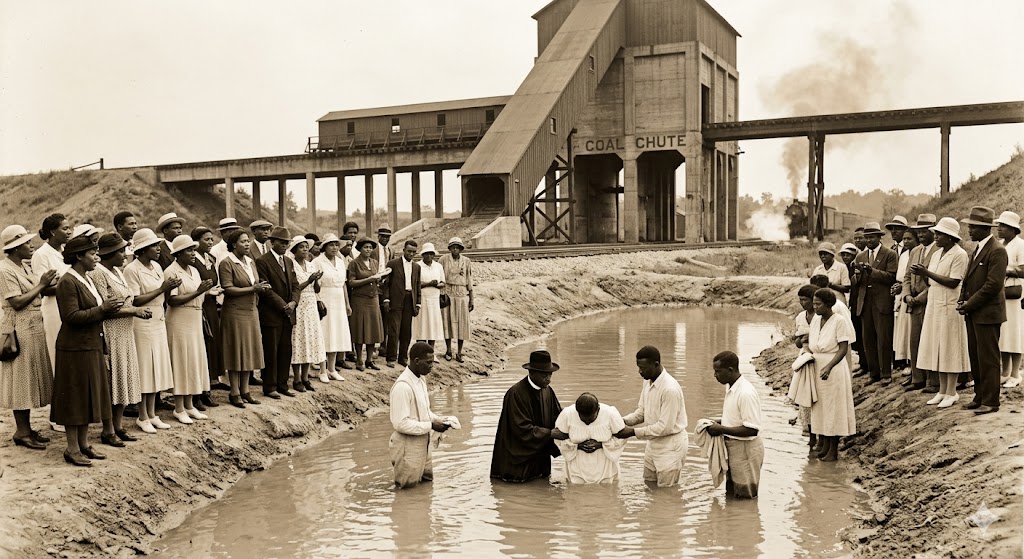
The Gospel and the Iron Horse: The Coal Chute Baptism of 1933
In the summer of 1933, the heat in Meridian didn’t just hang in the air—it hummed. It was the kind of heat that made the steel rails of the Southern Railway vibrate under the weight of passing engines.
On June 25th, at precisely 2:30 in the afternoon, a massive crowd gathered—not at a quiet riverbank or a manicured churchyard, but at the industrial heart of the city: the coal chute.
A brief notice in The Echo captured the moment:
“Baptizing will take place Sunday, June 25th at 2:30 o’clock on coal chute… The pastor is expecting the Rev. Pack to assist in the baptizing and also Rev. McElroy back to witness the event.”
— The Echo, June 23, 1933
For rural Black congregations in nearby counties like Newton, Meridian served as both a commercial and industrial center—making locations like the coal chute accessible, familiar, and practical gathering points.
To a modern reader, the idea of a baptism at a coal chute may sound gritty, even out of place. We imagine soot, grease, and towering black machinery. But in the 1930s, this “Coal Chute Baptism” can be understood as a powerful marriage of necessity and spiritual symbolism.
The Towering Giant: What Was the Coal Chute?
In Meridian—a major railroad hub of the South—the coal chute stood as a monument to the steam age. These structures, often massive towers built of timber or concrete, allowed hopper cars to dump large quantities of coal into holding bins. When a steam locomotive pulled alongside, a heavy metal chute would drop from the tower, feeding fuel into the engine’s tender by gravity.
But coal alone did not power the iron horse. Steam engines required constant water replenishment. For that reason, coal towers were almost always paired with nearby water sources—deep engineered reservoirs, dammed creeks, or cooling pools often referred to as “troughs” or “cisterns.”
It was here, at the intersection of fire and water, that something unexpected could happen.
Why the Chute? The Mechanics of Grace
The decision by ministers such as Rev. C.J. Boykins and Laban B. McElroy to use the coal chute site was not accidental. It reflects a careful blending of geography, theology, and lived reality.
The Depth
Baptist tradition requires full immersion. In the heat of a Mississippi summer, many natural creeks ran shallow. The reservoir at the coal chute—dredged deep to satisfy the thirst of locomotives—offered a reliable, cool depth sufficient for the sacred act of burial and rebirth.
The Scale
This was not a private ritual. With fifty-eight new members to be baptized, the event required space. The coal chute, a known public landmark, provided room for a large gathering—transforming an industrial site into a communal stage.
The Access
In the Jim Crow South, access to space was never neutral. Rivers, bridges, and open land often carried unspoken boundaries. Industrial zones like the coal chute—loud, utilitarian, and largely overlooked by white civic life—could offer Black communities a degree of autonomy. What appears unusual today was, in many cases, a practical claiming of space in a segregated world.
The Ritual of the Rails
Picture the scene.
Candidates dressed in white robes stand in stark contrast to the dark residue of coal dust. Families line the railway embankments, their voices rising in hymn as the distant hiss of steam echoes across the yard. The ground itself hums with industry, yet the focus is fixed on the water.
One by one, the candidates step forward.
As Laban B. McElroy stands among the ministers to witness the sacred rite, the ritual unfolds with solemn precision. Each believer is lowered beneath the surface of the reservoir, symbolically burying the “old life,” and raised again into newness.
In that moment, the coal chute becomes something more than machinery. It becomes sacred ground.
Sanctifying the Industrial World
By claiming the waters of the coal chute for baptism, the church was doing more than meeting a practical need—it was redefining space itself.
What had been built to fuel locomotives was repurposed to renew lives.
What once powered the engines of commerce became a vessel of spiritual transformation.
In a world structured by segregation and limitation, this act carried quiet power. It demonstrated that sacred space was not confined to church walls or designated landscapes. It could be made—claimed, even—in the most unlikely places.
Conclusion: Where the Gospel Found Water
Beneath the shadow of iron and steam, the coal chute was transformed.
What had once stood as a symbol of industry became, for a brief moment, a cathedral of the working community. The same water that sustained the engines of the South now bore witness to the renewal of its people.
The Coal Chute Baptism of 1933 reminds us of a deeper truth: in the Jim Crow South, Black faith did not wait for ideal conditions. It made sacred space wherever it could.
Even in the shadow of industry, the gospel found water deep enough to hold a new beginning.
Historical Note
This account is based on a notice published in The Echo (Meridian, Mississippi), June 23, 1933, along with contextual research on regional baptism practices and the ministry of Rev. L.B. McElroy.

Leave a Reply