The White Jesus in the Black Church
Colonialism, Survival, and the Face Hanging Above the Pulpit
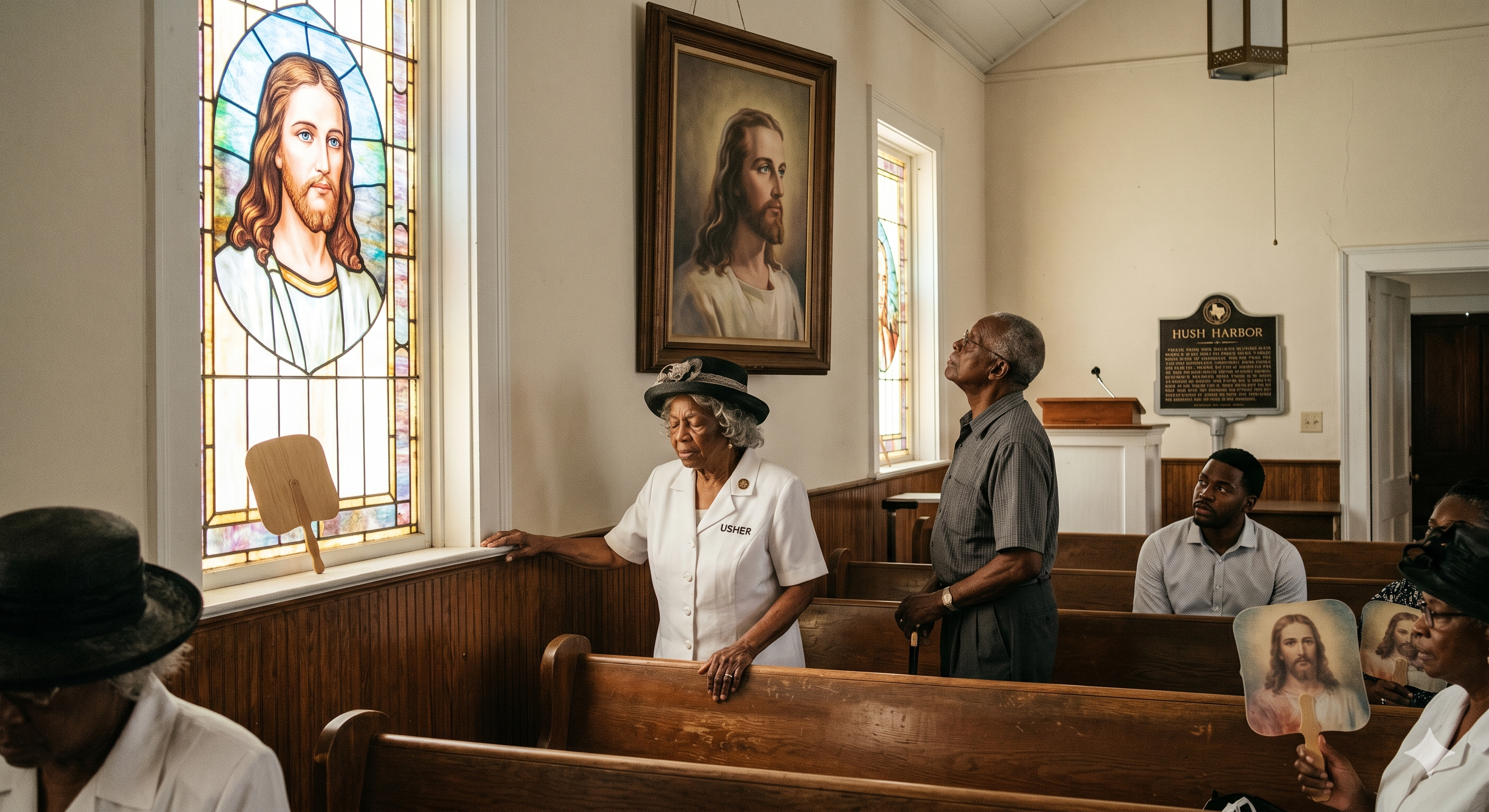
Walk into many historic Black churches across America and you may still find him hanging above the pulpit: a soft-faced, light-skinned Jesus with flowing brown hair and European features. His image appears in stained glass windows, old Sunday school books, funeral programs, framed portraits, and church fans tucked beneath wooden pews.
For some, that image is comforting — a symbol connected to childhood memories, grandmothers’ prayers, Sunday revivals, and generations of worship.
For others, it is deeply troubling — a reminder of colonialism, slavery, and the long shadow of white supremacy in America.
The question has become increasingly difficult to ignore:
Why does the Black church still embrace an image of Jesus that does not historically resemble the man from Nazareth?
The answer is layered, sitting at the volatile intersection of religion, history, psychology, survival, memory, and inherited tradition.
The Historical Reality vs. the European Tradition
Historically, Jesus was a Jewish man born in the Middle East under Roman rule. He likely possessed darker skin, dark hair, and the Semitic features common to first-century Judea.
The familiar European image of Jesus did not emerge from ancient Palestine.
It developed centuries later through European artistic traditions. Renaissance painters often depicted biblical figures in ways that reflected the people and cultural ideals surrounding them. Over time, European Christianity became the dominant global expression of the faith through empire, colonization, and missionary expansion.
As European powers spread across Africa and the Americas, so did European religious imagery.
The result was that millions of people across the world — including enslaved Africans in America — inherited a version of Christianity visually centered around whiteness.
This is where the conversation becomes painful.
Black people in America were enslaved, beaten, sold, and dehumanized by a society that largely identified itself as Christian. Slaveholders quoted scripture. Churches often remained silent about slavery or openly defended it. Enslaved Africans were frequently taught obedience-centered interpretations of the Bible while being denied literacy and autonomy.
Yet one of the most important truths in African American history is this:
The same religion used to justify oppression also became the language of hope, survival, resistance, and liberation.
Enslaved Black people identified not with Pharaoh, but with the Israelites in bondage. They found comfort in Moses, deliverance, and the promise that suffering would not last forever.
Even in the hidden “hush harbors” — secret worship gatherings held deep in woods and brush away from slaveholders’ oversight — enslaved Africans reshaped Christianity into something deeply spiritual, communal, and liberating. There, faith became a source of emotional survival and quiet resistance.
Consequently, the Black church evolved into far more than a religious institution.
It became:
- a refuge,
- a school,
- a political organizing space,
- a civil rights headquarters,
- and a source of dignity in a society determined to deny Black humanity.
Leaders like Martin Luther King Jr. preached from Black pulpits that became centers of protest and social transformation, while theologians like James Cone later challenged the ways Christianity had been entangled with racial power structures in America.
Within that long struggle, many Black Christians inherited the European image of Jesus without necessarily embracing the racial ideology behind it.
The Psychology of Representation
Still, critics argue that this imagery acted as a subtle form of conditioning.
Constantly portraying holiness, divinity, purity, and authority through white imagery can shape how people unconsciously view race and power. If God’s son is always depicted as white while Blackness is absent from sacred imagery, it communicates a powerful message — especially to children.
During segregation, many Black Americans grew up in a society where nearly every symbol of authority was white:
- presidents,
- judges,
- business owners,
- textbook heroes,
- movie stars,
- and even sacred figures.
Human beings absorb symbolism emotionally long before they analyze it intellectually.
Therefore, the concern is not merely about paint on canvas. It is about the psychology of representation.
When a society consistently associates holiness, beauty, intelligence, and authority with whiteness while marginalizing Blackness, those messages seep quietly into the culture whether acknowledged or not.
For many Black Christians, removing white depictions of Jesus eventually became part of reclaiming cultural and spiritual identity.
Why Some Black Churches Have Abandoned the Image
In recent decades, many Black churches and believers have intentionally moved away from white portrayals of Jesus.
Some now use:
- African depictions of biblical figures,
- Middle Eastern representations,
- multicultural religious art,
- or no physical images at all.
Their reasons generally fall into four categories:
Historical Accuracy
A desire for imagery that reflects the actual geographical and historical reality of Jesus’ life.
Cultural Healing
Removing white imagery as part of processing generations of racial trauma and colonial influence.
Theological Integrity
The belief that no single race should dominate sacred imagery because Christianity is meant to transcend ethnicity and nationality.
Reclaiming Identity
Restoring a sense of belonging and dignity long denied in Western religious art by depicting biblical figures with darker skin.
Why Many Still Hold Onto It
Yet many Black Christians continue to keep those traditional images in their homes and sanctuaries.
Why?
Because for them, the image is no longer primarily about race.
It is about memory.
It reminds them of:
- praying mothers,
- wooden pew churches,
- church revivals,
- funerals where hope held grieving families together,
- and elders who survived Jim Crow through a faith that carried them across impossible terrain.
To many older believers, removing the image can feel less like liberation and more like severing emotional ties to ancestors who held onto faith during profound suffering.
Others simply do not place much importance on physical depictions of Jesus at all. They view the image as symbolic rather than literal. Their focus remains entirely on Christ’s teachings, not his complexion.
And truthfully, for many believers, the image became normalized through generations of repetition without its racial implications ever being deeply questioned.
My Own Reflection
As I have grown older, I have found myself thinking more deeply about the images we inherit, and the meanings attached to them.
As children, most of us do not question the pictures hanging in churches or printed inside family Bibles. We simply accept them as part of the sacred world handed down to us by parents and grandparents. Only later do many begin asking where those images came from and what messages they may have carried beneath the surface.
Personally, I do not believe most Black Christians are worshipping whiteness when they hang those portraits in their homes.
I believe many are honoring the faith traditions that helped their families survive.
That distinction matters.
At the same time, I also do not believe imagery is meaningless.
Images shape imagination. They influence what societies associate with beauty, authority, innocence, wisdom, and divinity. Even when those influences operate quietly beneath the surface, they still shape cultural consciousness over time.
That is why there is value in asking difficult questions:
- Who gave us these images?
- Why were they normalized?
- What narratives did they reinforce?
- And what does spiritual freedom look like now?
Beyond the Frame
When we look beyond the frame, the debate over the image of Jesus becomes a larger conversation about identity, power, memory, and inherited narratives.
The issue is not whether salvation depends on skin color — it does not.
But neither is representation meaningless.
Perhaps the larger lesson is this:
Jesus was never meant to belong to one race, nation, or empire.
Every culture has historically imagined him through its own lens — African, European, Asian, Indigenous, and Middle Eastern alike. Maybe that says less about what Jesus looked like and more about humanity’s universal longing to see itself reflected in the divine.
The danger only begins when one image becomes dominant enough to define who is holy and who is not.
That is when faith can quietly become entangled with power.
And history shows us how dangerous that can be.
Final Reflection
The white Jesus image in the Black church survives because history survives.
It carries traces of colonialism, oppression, survival, grief, resilience, tradition, memory, and faith all at once.
Some believers choose to let go of the image as part of reclaiming historical truth and cultural identity.
Others continue holding onto it because it remains tied to generations of sincere spiritual endurance.
Neither side can be fully understood without acknowledging the long and painful history Black Americans endured — and the central role the church played both in that suffering and in overcoming it.
Perhaps the most important question is not:
“What color was Jesus?”
Perhaps the deeper question is:
What have we been taught to associate with holiness, power, beauty, and humanity — and why?
Leave a Reply