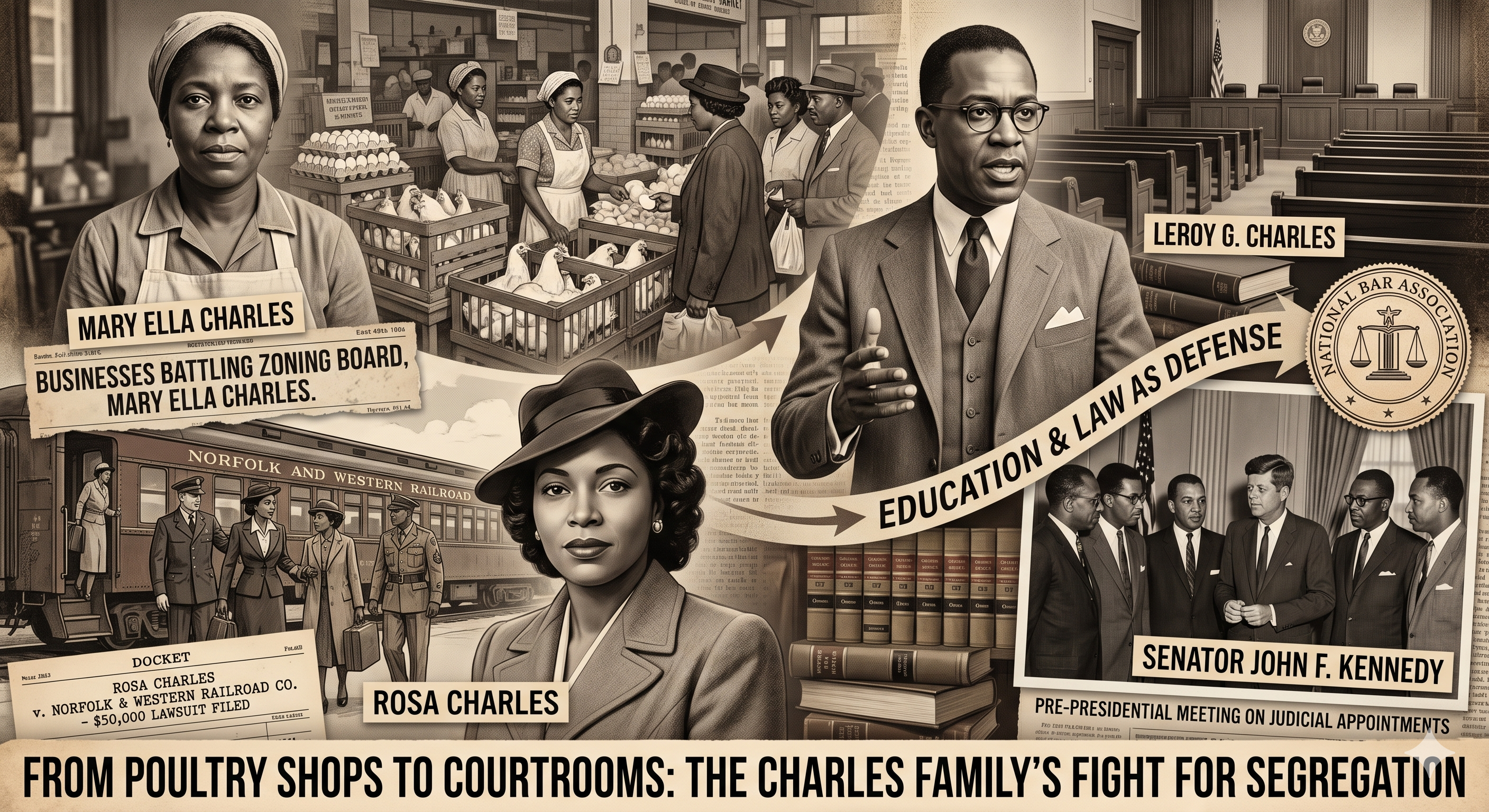
From Poultry Shops to Courtrooms
How the Charles Family Fought Segregation Long Before the Civil Rights Era
Long before the marches of the 1960s, before the televised images of Birmingham and Selma, and before the Civil Rights Movement became a defining chapter of American history, Black families across the country were already confronting systems designed to limit their freedom, mobility, and opportunity.
Some fought in courtrooms.
Some fought through business ownership.
Some fought through education.
And some fought simply by refusing to surrender their dignity.
The story of the Charles family of Chicago reveals how one Black migrant family challenged racial inequality decades before the modern Civil Rights Movement reached its peak. Their story stretches from the rural South to the crowded streets of Bronzeville, from neighborhood poultry markets to national legal organizations, and from segregation-era train cars to meetings connected to the future administration of President John F. Kennedy.
At the center of this story stood Mary Ella Collier Charles, her son LeRoy G. Charles, and his wife Rosa Charles—a family whose lives reflected the broader struggle of Black America in the first half of the twentieth century.
Leaving the South, But Not Escaping Racism
Like thousands of African American families during the Great Migration, the Charles family left the South searching for opportunity, economic stability, and personal safety.
Mary Ella Collier Charles, whose roots traced back to Newton County, Mississippi, lived through an era when Black families in the rural South faced crushing poverty, racial violence, political exclusion, and limited educational opportunities. The family first spent time in Alabama before eventually joining the migration northward to Chicago.
For many Southern Black migrants, Chicago represented possibility:
- industrial jobs,
- Black-owned businesses,
- political influence,
- educational advancement,
- and a chance to escape the rigid racial hierarchy of the Jim Crow South.
But arrival in the North did not mean freedom from discrimination.
Instead, Black migrants often encountered a different form of racial exclusion hidden beneath the language of zoning ordinances, licensing regulations, segregated housing patterns, and institutional barriers.
The Charles family would spend decades confronting those obstacles directly.
Mary Ella Charles and the Business of Survival
Many Great Migration stories focus on male factory laborers and railroad workers, but Black women were often the true architects of family survival and advancement.
Mary Ella Charles became one of those women.
In Chicago’s South Side Black community, she operated neighborhood poultry markets that sold chickens, turkeys, eggs, and fresh dressed poultry to local residents. During the 1930s, 1940s, and 1950s—before large supermarket chains dominated urban neighborhoods—small poultry stores were essential community businesses. Families frequently depended on these neighborhood markets for fresh meat and eggs purchased directly from merchants they knew personally.
On the crowded South Side sidewalks of Bronzeville, where storefront signs competed for attention beneath elevated train tracks and busy streetcar routes, businesses like Mary Ella’s poultry markets became vital neighborhood institutions.
Her stores represented far more than simple retail operations. They symbolized economic independence during a time when Black entrepreneurs routinely faced discrimination from banks, suppliers, licensing agencies, and city governments.
Operating a Black-owned poultry market in segregated Chicago required persistence, political navigation, and constant legal vigilance.
The Charles family repeatedly found themselves battling city licensing officials and zoning authorities over permits connected to their poultry stores on East 49th Street and East 61st Street. Newspaper accounts documented their lengthy legal struggles to continue operating businesses they had managed for years.
At one hearing, attorney LeRoy Charles argued before the zoning board that the family had lawfully operated one of the poultry markets for more than two decades. Yet shifting city regulations threatened the survival of the business.
The struggle reflected a larger reality across urban America:
Black entrepreneurship was often tolerated only until it became economically significant or politically inconvenient.
Still, the family endured.
The Intergenerational Bridge: Poultry to Progress
The physical labor of the poultry markets became the literal engine of the family’s upward mobility.
Every crate of poultry unloaded onto South Side sidewalks, every customer served across the counter, and every dollar earned inside Mary Ella’s stores carried a deeper purpose: feeding both the neighborhood and the future of the Charles family itself.
Income from Mary Ella’s poultry markets buffered the family against Depression-era and postwar instability. More importantly, the businesses created the financial foundation necessary to educate her children and help launch a new generation into professional life.
During an era when banks routinely denied loans to Black students and aspiring professionals, Mary Ella’s storefront effectively became the family’s private financial institution.
Her labor funded opportunity.
The income generated from poultry sales helped support LeRoy Charles’s educational advancement and eventual legal career. What began as neighborhood business survival gradually evolved into something much larger—a pathway into legal advocacy, institutional leadership, and national political influence.
Mary Ella’s work behind the counter ultimately helped place her son inside courtrooms, bar associations, and meetings with some of the most influential political leaders in America.
That generational transformation was no accident.
It was built one day of labor at a time.
Education as Defense and Advancement
For many Black families living under segregation, education represented more than social advancement.
It represented defense.
LeRoy Charles came of age during the height of Bronzeville’s intellectual and cultural expansion. The South Side of Chicago had become a thriving center of Black newspapers, churches, businesses, civic organizations, educational societies, and social clubs.
As a young man, LeRoy participated in organizations such as the Chavanon Social Club and other educational and civic groups that helped cultivate Chicago’s growing Black middle class.
These organizations were not simply entertainment spaces.
They functioned as:
- networking systems,
- leadership incubators,
- intellectual circles,
- educational support structures,
- and gateways into professional life.
The elegant dances, club meetings, and educational forums hosted across Prairie Avenue, Michigan Avenue, and Bronzeville’s crowded social halls often became the training grounds for future Black lawyers, educators, entrepreneurs, and civic leaders.
While continuing to help support his family through work connected to the poultry business, LeRoy pursued higher education and eventually entered the legal profession.
That achievement carried enormous significance in mid-century America.
Black attorneys occupied a uniquely important role during segregation. In many communities, they became:
- defenders against discriminatory laws,
- advocates for Black-owned businesses,
- negotiators with city governments,
- and architects of future civil rights litigation.
Long before Brown v. Board of Education, Black lawyers across the country were already organizing through professional associations and legal networks to challenge institutional inequality through the courts.
LeRoy Charles became part of that broader movement.
Rosa Charles and the Violence of Jim Crow Travel
One of the most powerful episodes in the Charles family story occurred during the 1940s when Rosa Charles, wife of attorney LeRoy Charles, became the victim of racial violence while traveling through Virginia aboard a Norfolk and Western Railroad train to visit her husband at Camp Lee.
According to newspaper reports and court filings, Rosa was accused of occupying a train car reserved for white passengers while traveling through Roanoke, Virginia.
What followed was brutal.
Rosa alleged that railroad employees, a detective, and a military policeman forcibly removed her from the train. She stated she was beaten, dragged from her seat, separated from her luggage, jailed, and forced to wire Chicago for bond money.
The humiliation was public.
The violence was institutional.
And the message was unmistakable:
even educated, middle-class Black travelers could still be subjected to the full force of Jim Crow authority.
But Rosa Charles refused silence.
She filed a $50,000 lawsuit against the railroad for assault and false imprisonment.
That decision alone represented an act of extraordinary courage.
In the 1940s, many Black Americans feared retaliation for publicly challenging white-controlled institutions. Lawsuits against railroads, police agencies, or segregation systems carried enormous personal and financial risk, particularly for Black women.
Contextualizing the Verdict
Rosa Charles ultimately lost her case before an all-white jury—an outcome that reflected the architecture of the Jim Crow legal system itself.
At the time, interstate travel technically fell under federal authority, but southern states aggressively enforced local segregation customs through transportation systems, policing, and courtroom procedures.
The trial judge reportedly instructed jurors to heavily consider the railroad’s right to establish its own “rules and regulations” regarding racial separation, effectively validating segregation as a legitimate corporate practice.
Meanwhile, the railroad defense lawyers relied upon prevailing racial and gender stereotypes to undermine Rosa’s credibility, portraying an educated Black woman demanding equal treatment as disruptive rather than victimized.
Under such conditions, an all-white jury drawn from a system that systematically excluded Black citizens from meaningful participation required little time to side with the railroad.
Yet the legal defeat was not a total loss.
LeRoy Charles and the legal team continued pressing the matter through appeals, eventually securing a remand for a new trial based on flawed jury instructions concerning segregation authority and corporate liability.
More importantly, the case forced white institutions to publicly defend segregation practices within the courtroom itself.
The lawsuit exposed the mechanics of racial injustice on the public record.
And it revealed something historically vital:
Black resistance did not suddenly emerge during the 1950s.
Families like the Charleses had already been challenging racial exclusion through litigation, business ownership, and organized legal strategy for decades.
The Evolution of Charles Family Resistance
MARY ELLA CHARLES
Poultry Market Entrepreneur
Built family financial independence through Bronzeville storefront businesses.
↓
Funded higher education and legal advancement
LEROY G. CHARLES
Attorney and Civic Leader
Shifted the struggle from local zoning disputes into courtrooms, legal associations, and national advocacy circles.
↓
Leveraged legal institutions for accountability and representation
ROSA CHARLES
Anti-Segregation Litigant
Refused to quietly accept Jim Crow violence and forced systemic racial injustice into the public legal record.
The National Bar Association and Black Legal Power
As LeRoy Charles matured professionally, his work extended far beyond neighborhood business disputes and local courtroom representation.
He became deeply involved with the National Bar Association and the Cook County Bar Association—organizations that served as critical institutions for Black attorneys who were often excluded from white-controlled legal networks during segregation.
Through these organizations, LeRoy worked alongside some of the leading Black legal minds of the era.
Newspaper coverage placed him in:
- fundraising campaigns for the Chicago Urban League,
- planning committees for National Bar Association conventions,
- civic leadership circles,
- and discussions surrounding federal judicial appointments and civil rights representation.
Photographs and newspaper articles documented LeRoy participating in gatherings with nationally recognized Black attorneys, judges, educators, and political leaders.
Most strikingly, he appeared among legal representatives meeting with Senator John F. Kennedy before Kennedy became President of the United States.
The discussions centered on representation within the federal judiciary and the need for qualified Black judges and attorneys to receive fair consideration within the American legal system.
This was not protest politics in the traditional sense.
This was institutional strategy.
These Black attorneys understood that courts, judgeships, and federal appointments shaped the future of racial justice in America.
Long before the Civil Rights Movement reached national television screens, Black legal professionals were already fighting critical battles inside boardrooms, legal associations, political offices, and courtrooms.
LeRoy Charles stood among them.
Bronzeville’s Black Middle Class
The Charles family story also reflects the broader rise of Chicago’s Black middle class during the twentieth century.
Their lives intersected with:
- Black social clubs,
- educational organizations,
- civic institutions,
- business ownership,
- legal networks,
- and national Black leadership circles.
Bronzeville was more than a neighborhood.
It became a city within a city—a place where Black migrants built newspapers, churches, insurance companies, music venues, political organizations, and professional networks despite segregation and discrimination.
The sidewalks bustled with shoppers, newspaper vendors, churchgoers, musicians, and entrepreneurs trying to carve stability and dignity out of an unequal system.
Families like the Charleses helped construct that world.
Their story reminds us that the Great Migration was not simply about relocation.
It was about institution building, economic survival, professional advancement, and the long struggle for equal citizenship.
The Fight Did Not Begin in the 1960s
Too often, American history reduces Black resistance to a handful of famous moments and national figures from the mid-twentieth century.
But the Charles family reminds us that the struggle was already alive decades earlier.
Mary Ella Collier Charles fought through entrepreneurship.
LeRoy Charles fought through law and civic leadership.
Rosa Charles fought by publicly challenging racial violence and refusing to quietly accept humiliation.
Together, their lives reveal a deeper truth about Black history in America:
The Civil Rights Movement did not emerge from nowhere.
It was built upon generations of ordinary families who spent decades confronting exclusion in businesses, courtrooms, neighborhoods, schools, transportation systems, and public spaces long before the nation finally began paying attention.
sources
- 1920 U.S. Census, Jefferson County, Alabama, population schedule, Ensley–Mulga Road district, household of Dock Charles; documenting the Charles family’s residence in Alabama during the early years of the Great Migration.
- 1930 U.S. Census, Cook County, Illinois, Chicago Ward 4, Prairie Avenue, household of Dock and Mary Charles; documenting the family’s settlement in Chicago’s South Side Black Belt community.
- Isabel Wilkerson, The Warmth of Other Suns: The Epic Story of America’s Great Migration (New York: Random House, 2010), discussing the role of The Chicago Defender and northern migration networks among Southern Black families.
- 1940 U.S. Census, Cook County, Illinois, Chicago, household of Mary Charles; identifying Mary Charles as owner and employer of a poultry business.
- “License Court Fines Four Merchants for Overcharge,” Chicago Tribune (Chicago, Illinois), January 25, 1947; documenting legal disputes involving the Charles family poultry market and city licensing enforcement.
- “Poultry Shop Owners Appeal City’s Ruling,” Chicago Tribune (Chicago, Illinois), November 1, 1953; documenting zoning appeals involving Charles family poultry businesses on East 49th Street and East 61st Street.
- “Poultry Shop Appeals OK’d on South Side,” Chicago Tribune (Chicago, Illinois), November 8, 1953; reporting successful appeals allowing continued operation of Charles family poultry markets.
- “Big School Opening Dance,” Chicago Defender (Chicago, Illinois), September 1932; documenting LeRoy Charles’s leadership role within the Chavanon Social Club.
- “Wilsonites Hold Buffet Supper,” Chicago Defender (Chicago, Illinois), June 1936; noting LeRoy Charles’s involvement in educational and civic student organizations while attending Woodrow Wilson Junior College.
- 1940 U.S. Census, Cook County, Illinois, Chicago, household of Mary Charles; documenting LeRoy Charles as having completed three years of college while employed in the poultry business.
- Kenneth Kusmer, A Ghetto Takes Shape: Black Cleveland, 1870–1930 (Urbana: University of Illinois Press, 1976), discussing the importance of Black-owned businesses and professional institutions in northern urban Black communities during segregation.
- “Asks $50,000 From Railroad For Assault,” Chicago Defender (Chicago, Illinois), September 13, 1947; documenting Rosa Charles’s lawsuit against the Norfolk and Western Railroad for assault and false imprisonment.
- “Chicago Woman Loses $50,000 Railroad Suit,” Chicago Defender (Chicago, Illinois), October 1, 1949; detailing the jury verdict in Rosa Charles’s segregation-era railroad lawsuit.
- Plessy v. Ferguson, 163 U.S. 537 (1896); establishing the legal doctrine of “separate but equal” that shaped segregation policies throughout the Jim Crow era.
- “Lawyers Behind League’s Drive,” Chicago Defender (Chicago, Illinois), August 17, 1957; listing LeRoy Charles among attorneys participating in fundraising efforts for the Chicago Urban League.
- “1,000 Lawyers To Attend 33rd National Convention,” Chicago Defender (Chicago, Illinois), August 16, 1958; documenting LeRoy Charles’s participation in National Bar Association convention planning.
- “Charles Lane To Head Attorneys,” Chicago Defender (Chicago, Illinois), December 27, 1958; documenting LeRoy G. Charles’s election as Second Vice President of the Cook County Bar Association.
- “Mayor, Lawyers Honor Judge Green At Banquet,” Chicago Defender (Chicago, Illinois), February 28, 1959; identifying LeRoy Charles among prominent Black attorneys and legal leaders in Chicago.
- “Senator Kennedy and Lawyers Representing the National Bar Association,” Chicago Defender (Chicago, Illinois), September 24, 1960; documenting LeRoy Charles’s participation in meetings with Senator John F. Kennedy regarding federal judicial representation.
- “Select Judges On Merit—Jack,” Chicago Defender (Chicago, Illinois), October 22, 1960; discussing National Bar Association meetings concerning judicial appointments and racial representation within the federal judiciary.
- St. Clair Drake and Horace R. Cayton, Black Metropolis: A Study of Negro Life in a Northern City (New York: Harcourt, Brace and Company, 1945), discussing Bronzeville’s development as a center of Black institutional, professional, and economic life in Chicago.
- Thomas J. Sugrue, Sweet Land of Liberty: The Forgotten Struggle for Civil Rights in the North (New York: Random House, 2008), examining northern segregation, discriminatory zoning, and legal struggles faced by Black communities before the modern Civil Rights Movement.
- Harvard Sitkoff, The Struggle for Black Equality, 1954–1992 (New York: Hill and Wang, 1993), discussing how mid-century civil rights activism emerged from decades of earlier Black institutional organizing and legal advocacy.
- Cook County, Illinois, death records and obituary notices for LeRoy G. Charles, documenting his death on May 15, 1990.
Leave a Reply