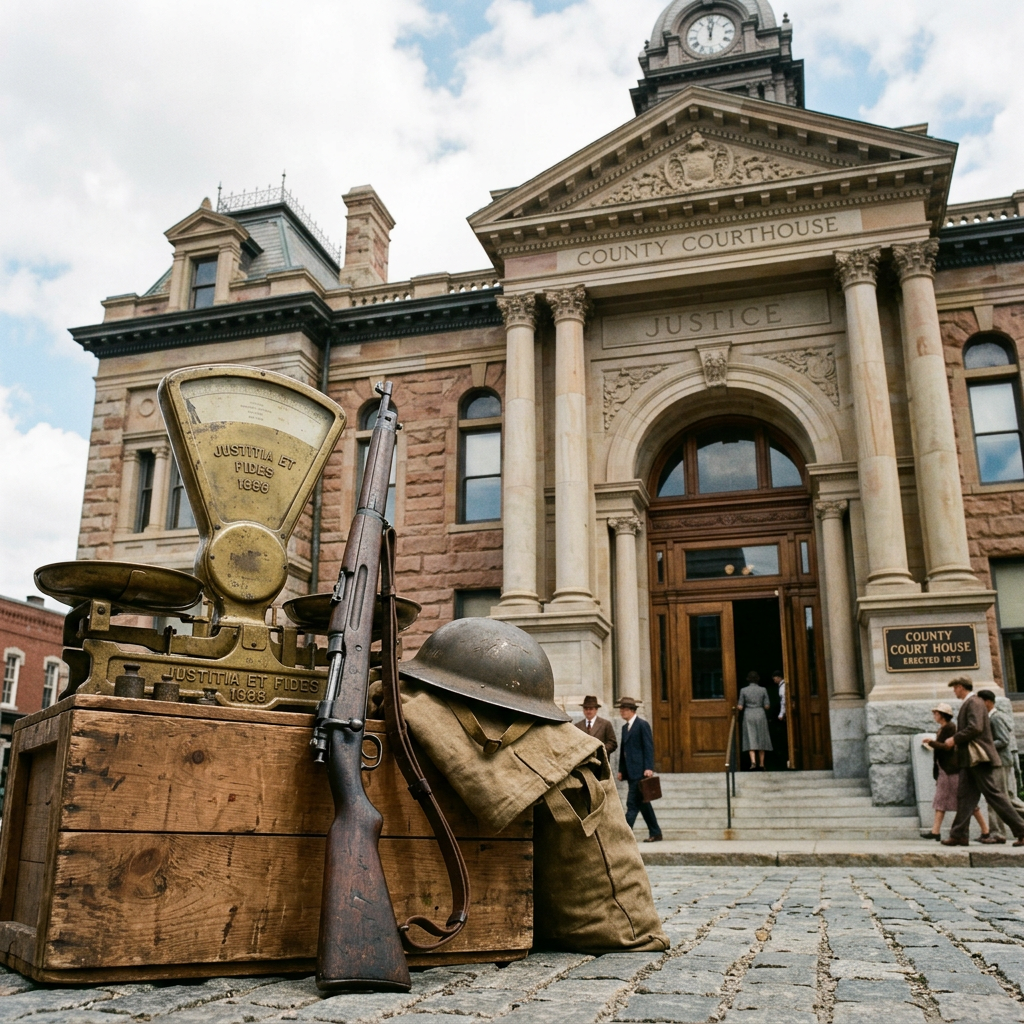
Pip: There's a moment in 1945 Mississippi where a row of armed soldiers surrounds a courthouse, and the headlines call it protection. Samp has been digging into what that word actually meant.
Mara: This episode follows that case — Major Hopkins, Newton County, and the question of whether state power shielding a Black man from a mob constitutes justice, or just a different instrument of the same system.
Pip: Let's start with the thin line between those two things.
—
A Thin Line of Bayonets: State Power and the Meaning of Protection
Mara: In late 1945, Newton County, Mississippi became briefly visible to the nation — not because of a lynching, but because one didn't happen. The question the post puts at the center is whether that absence of mob violence actually meant something, or whether it was just the state managing its own image.
Pip: The post frames it plainly. After Hopkins entered a guilty plea, the conclusion reads: "the state had 'protected' him from the rope only to ensure that he would spend the remainder of his life in the Mississippi State Penitentiary at Parchman."
Mara: That's the upshot in full. Hopkins was roughly twenty years old, accused of attempting to assault a white teenage girl and striking a white man with a hammer — accusations that, in the racial climate of 1945, the post calls "social death warrants." He was captured weeks later at a sawmill in Tchula and held in Jackson deliberately, to keep him out of Newton County until the state could control the situation.
Pip: A manhunt with bloodhounds from Hazlehurst, a transfer to the capital, soldiers ringing the courthouse — and at the end of it, ninety-nine years at Parchman. The machinery was thorough.
Mara: The post draws a sharp contrast between how local and national press covered the trial. Local Mississippi papers emphasized the drama of the accusation and the fugitive search. National wire services led with the troops — headlines like "Guard Escorts Negro" and "State Guard Used on Another Trial" carried an implicit message: Mississippi was governed by law, not mobs.
Pip: Which is a useful story if you're a Southern governor watching Soviet propaganda point at American lynchings during the early Cold War.
Mara: Exactly that context. The post traces why lynching declined after 1930 — NAACP documentation campaigns, international pressure, World War II positioning the U.S. as democracy's defender. Southern states began intervening to prevent mob violence not to protect Black defendants, but to preserve state authority over punishment. The mob was replaced by the courthouse and Parchman.
Mara: By the 1950 Census, Hopkins appears in official records as Prisoner 552 at the Mississippi State Penitentiary. He survived the mob and was absorbed into what historians have called "slavery by another name."
Pip: The soldiers weren't there for Major Hopkins. They were there for Mississippi's reputation — and that distinction is the whole argument.
Mara: And the post notes that the 1950s tested even that restraint, as violence adapted toward targeting civil rights activists rather than criminal defendants — a reminder that the machinery of state power could turn in either direction.
—
Pip: "Protection" doing a lot of work in that headline, and almost none of it for the person being protected.
Mara: The case holds that tension without resolving it cleanly — which is probably the honest place to leave it. More from Our Unique Stories next time.
Leave a Reply