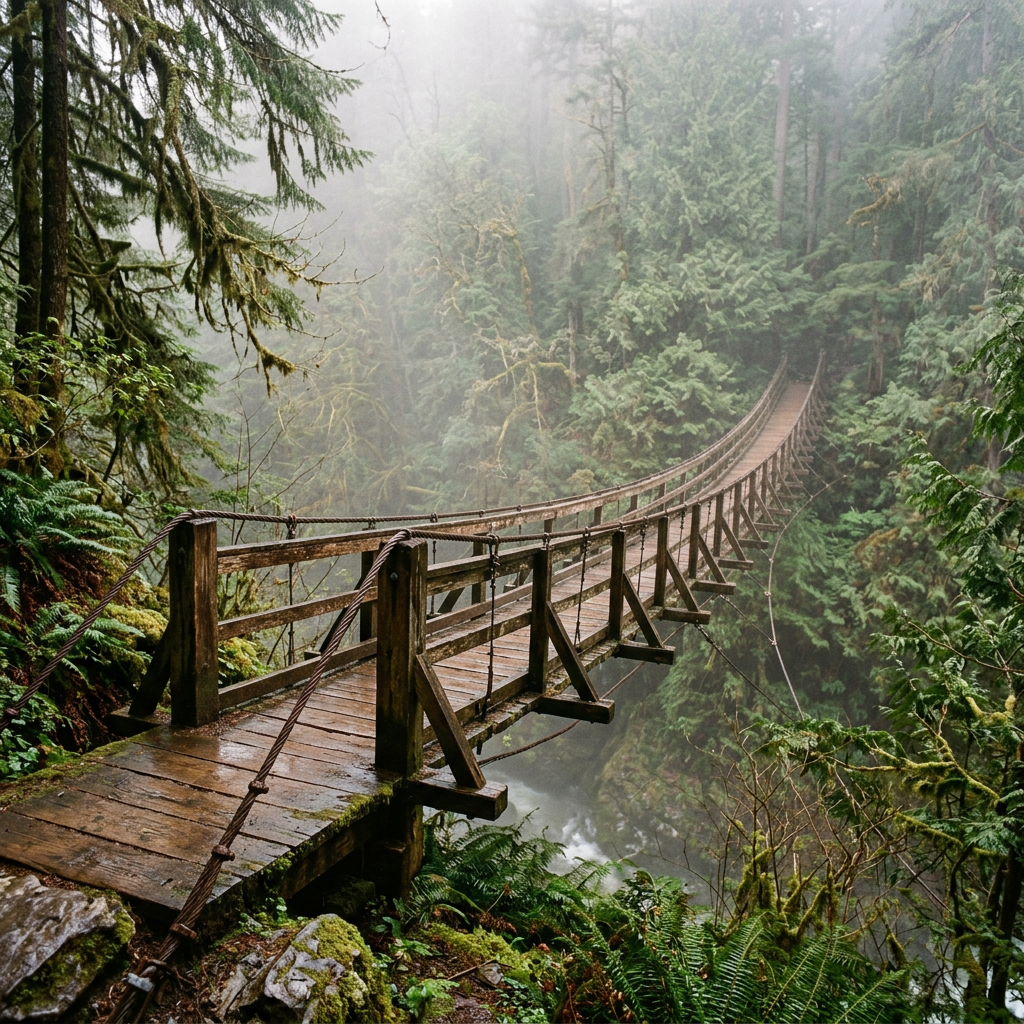
Pip: There's a gate on a road in Mississippi that doesn't just block a path — it blocks a reckoning. And Samp, writing for Our Unique Stories, drove straight toward it anyway.
Mara: This episode follows that drive into Shubuta, Mississippi — the Hanging Bridge, the four young people killed there in 1918, and why letting that site disappear into overgrowth is its own kind of verdict. Let's start with the gate itself, and what it's guarding.
The Gate and the Overgrowth: Why We Can't Let Shubuta's Hanging Bridge Vanish
Pip: The Shubuta Hanging Bridge isn't just a historical site — it's a test of whether we're willing to hold the full weight of what happened there. The question the post puts to us is whether silence and overgrowth are accidents, or choices.
Mara: The post describes arriving at the site and finding the road blocked — and sets up what that blockage means: "That gate is more than a barrier; it is a metaphor for a century of silence."
Pip: A century of silence with a padlock on it. And what fills that silence is the actual story, which the post reconstructs from census records and newspaper accounts — because the official narrative doesn't hold up.
Mara: The census records are where the post does its sharpest work. Major and Andrew Clarke were fourteen and eleven in 1910 — students, literate. Maggie House was approximately twenty-two by 1918; her sister Alma was seventeen. The post's summary is direct: "By the time they were killed, they had not yet been allowed to fully live."
Pip: And Maggie House was pregnant. That detail doesn't get softened.
Mara: It doesn't. The post also walks through the official account of the crime — Dr. E. L. Johnston shot in his barn, Major Clarke named as the killer — and notes the contradictions the story contains even on its own terms. The full truth, it acknowledges, may never be recoverable.
Mara: What is recoverable is what happened next. A mob handcuffed the jailer, took his keys, drove the four prisoners to the Chickasawhay River, and hanged them from the bridge's steel girders. The post's verdict on that sequence is unambiguous: "Whatever happened in that barn, justice was never allowed to happen in a courtroom."
Pip: The coroner's jury returned the standard finding — death at the hands of unknown persons. No arrests. The NAACP demanded action from Washington; the post notes that at that point, twenty-six lynchings had already occurred after Woodrow Wilson publicly condemned the practice. The response was silence.
Mara: And the post connects that silence to the Great Migration — framing departure not as ambition but as survival. "You didn't leave for opportunity — you left to survive." Letting the bridge disappear, the post argues, is that same silence continuing by other means.
Pip: Memory doesn't live in iron and wood alone — it lives in the people who keep driving toward that gate even when it's closed. That's the argument, and it lands.
Mara: Preservation isn't about revisiting trauma. It's about refusing to let the mob have the final word. The names matter: Major, Andrew, Maggie, Alma — lives, not headlines.
Pip: Which raises a question that runs under all of this — how communities hold onto places that powerful forces would rather let vanish.
Mara: The Shubuta bridge is still there, still gated, still disappearing into the brush. The post ends with an instruction: keep going back, keep saying the names.
Pip: History that can't be visited starts to feel like it didn't happen. That's not an accident — and next time, we'll keep pulling on that thread.
Leave a Reply