Pip: Dust-coated record rooms aren't where most people expect to find a revolution, but here we are — Newton County, Mississippi, where the real story of Reconstruction is written in deed transfers and crop-lien contracts.
Mara: This episode draws on Samp's work at Our Unique Stories, tracing how power shifted in the post-Civil War South — who lost land, who gained leverage, and what the paperwork left behind.
Pip: Let's start with the class that didn't survive the transition.
The Vanishing Class
Mara: The question this post opens with is deceptively quiet: what do land records from the 1860s and 70s actually tell us about power? The answer turns out to be a collapse story written in deed transfers.
Pip: And the post frames it precisely. The source puts it this way: "The transition from slavery to free labor wasn't just an accounting shift; it was a psychological earthquake."
Mara: That line does a lot of work. The planter class wasn't simply losing income — they were losing the entire architecture of authority they had built their identity around. Land-rich, cash-poor, and what the post calls "authority-bankrupt."
Pip: Which is where it gets genuinely interesting. The deeds don't show a labor shortage — they show labor independence. Freedmen and women exercised what the post calls their most radical new right: the right to walk away.
Mara: And that reframing matters. A planter in 1860 commanded fifty people without question. By 1866, that same planter had to negotiate individual contracts with people who could choose their employer or simply refuse.
Pip: For a lot of former slaveholders, apparently, negotiating was worse than losing the land entirely. So they sold.
Mara: Into that vacuum stepped the merchants. As old family names disappeared from the tax rolls, merchant names replaced them — and merchants weren't interested in managing fields. They wanted to manage the financing of fields.
Pip: Through the crop-lien system, as the post puts it, "the merchant replaced the master." Seeds, tools, and bacon on credit — and suddenly both Black and white farmers were tied to the land through debt rather than chains.
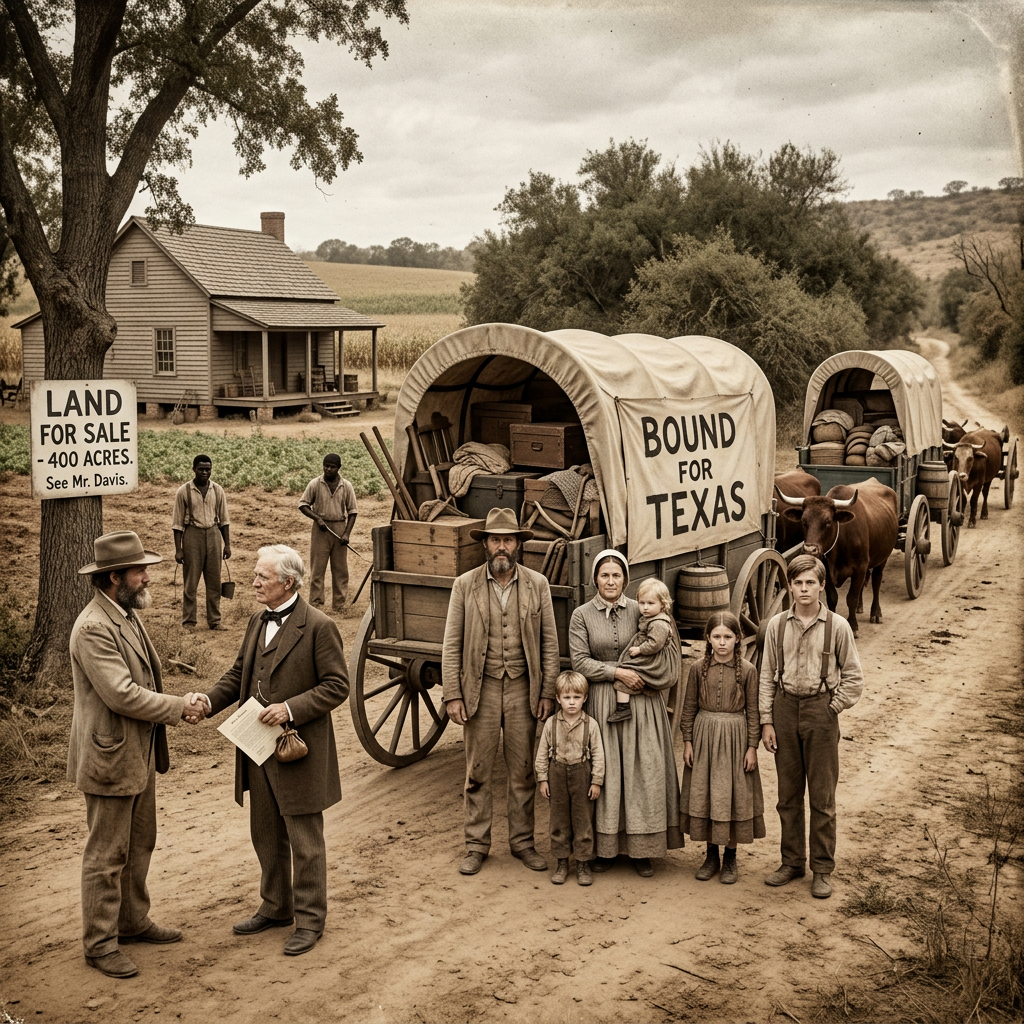
Mara: The post also tracks where the planters went. By the 1870s, a "G.T.T." — Gone To Texas — note was often all that remained of a prominent Newton County family. The West promised cheaper land and, crucially, a social frontier where old hierarchies hadn't yet been dismantled.
Pip: So what the deed records actually document is a liquidation of a lifestyle, not just a change of ownership.
Mara: Exactly. A 500-acre tract broken into ten small lots isn't just a real estate transaction — it's an empire unraveling one parcel at a time, replaced not by equality but by contracts and interest rates.
Pip: The power didn't go bad because the land did. The land went because the power already had.
Mara: What stays with me is the crop-lien system as the quiet successor — debt doing what force once did.
Pip: Same architecture, different paperwork. Next time, more from Newton County's records — and whatever else the dust turns up.
Leave a Reply