Am I My Brother’s Keeper? The Forgotten Veteran and the African American Experience
“And the Lord said unto Cain, Where is Abel thy brother? And he said, I know not: Am I my brother’s keeper?” — Genesis 4:9 (KJV)
Few questions in Scripture are as enduring—or as deeply uncomfortable—as the one Cain asked after God confronted him about his brother Abel.
It echoes across generations because it forces us to look in the mirror and examine our obligations to one another. Do we bear responsibility for our neighbors? Our elders? The vulnerable among us? Those who once sacrificed everything on our behalf? Or is each person ultimately left to fend for themselves?
For African American communities, that question has historically been answered not with words, but with survival. Throughout slavery, segregation, economic disenfranchisement, and social exclusion, Black communities survived because people chose to become their brother’s keeper. Families stretched boundaries to take in others. Churches fed the hungry. Neighbors watched over children. Communities pooled their meager resources to bury the dead, educate the young, and protect the elderly.
Yet every generation is challenged to answer this question anew.
The tragic story of one Mississippi veteran reminds us why this question still matters.
A Veteran Forgotten by Time
In January 1985, one of the most brutal cold-weather events in Mississippi history descended upon Newton County. Temperatures plummeted to near zero, and wind chills dropped deep into the negatives. Homes across the county groaned and struggled against the bitter, unprecedented cold.
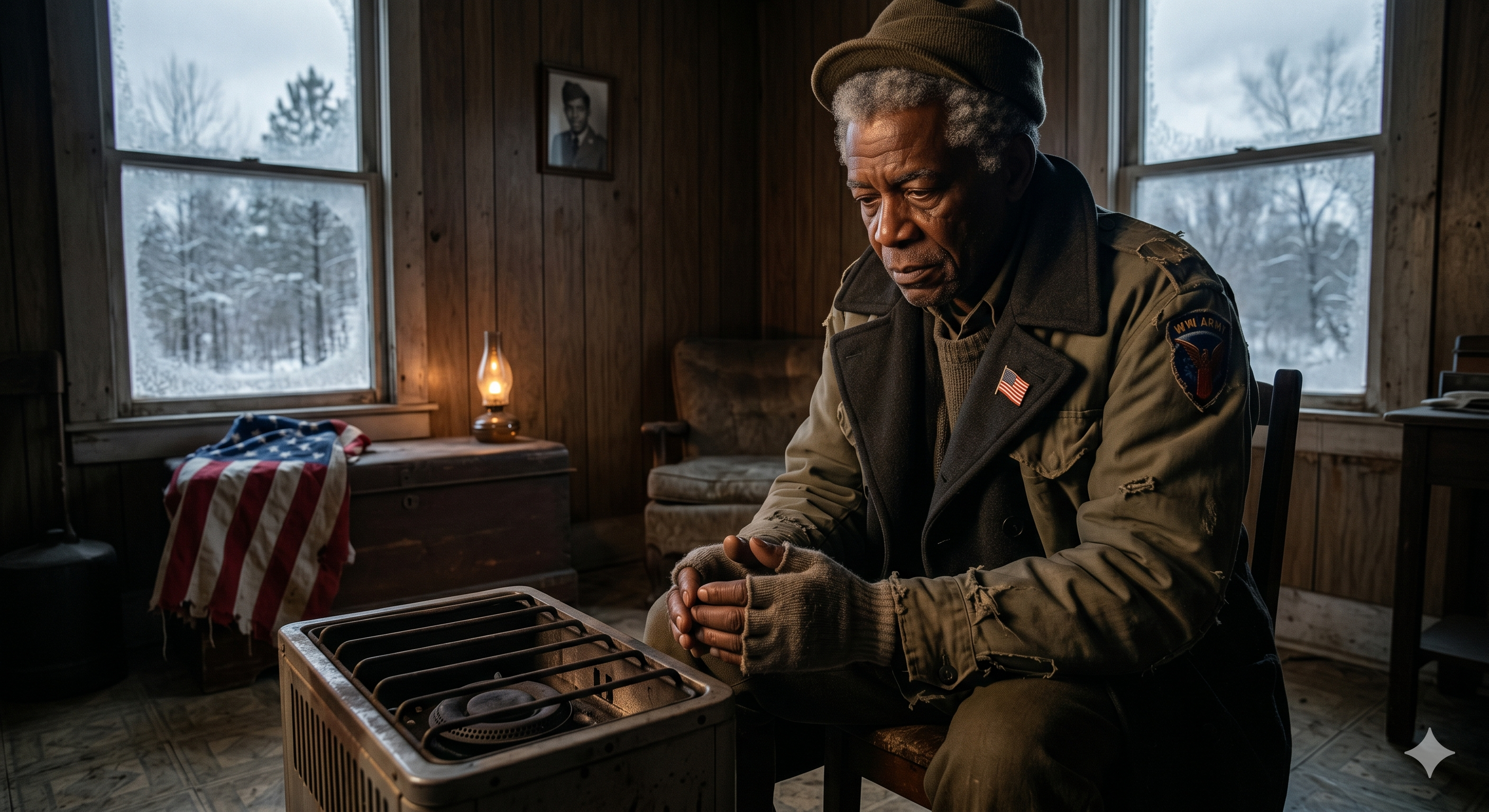
When the weather finally broke, seventy-two-year-old World War II veteran John Thomas “J. T.” Collier was found dead inside his Lawrence, Mississippi home. The coroner ruled his death accidental, caused by hypothermia.
Newspaper reports noted a devastating detail: his house had no electricity and was heated only by a small gas heater. The historic cold had simply proven too much for the aging structure and the elderly veteran living inside it.
The facts themselves are heartbreaking. But beneath the tragedy lies a difficult question: How does a man who served his country during World War II freeze to death alone in his own home?
And perhaps more urgently: Where was the safety net? Where was the community?
Yet history requires humility. We do not know who checked on J. T. We do not know what efforts may have been made on his behalf. We do not know who cared. What we know is only the outcome. The questions remain not because the answers are clear, but because they are not.
The African American Veteran’s Double Journey
For generations, African Americans have answered America’s call to service with remarkable patriotism, even when that patriotism was not always fully returned.
Black Americans in Military History:├── Civil War ── Fighting for liberation and citizenship.├── Buffalo Soldiers ── Serving on the western frontier.├── World Wars I & II ── Defending democracy in segregated units.└── Korea, Vietnam, & Beyond ── Serving a nation still grappling with equality.
Many volunteered or accepted the draft despite living in a nation that denied them equal treatment. They wore the uniform of a country that did not fully recognize their citizenship. When they returned home from the battlefields of Europe and the Pacific, many discovered that military service had not erased the barriers of Jim Crow. Opportunities remained segregated. Economic advancement remained difficult. Access to housing, education, and employment often remained unequal.
Yet they persevered.
In places like Newton County, Mississippi, African American veterans returned not to prosperity, but to farms, timber jobs, school cafeterias, churches, and small rural communities. They became the backbone of local life. Their names rarely appeared in history books, but their labor helped sustain families, congregations, and entire communities for decades.
They returned home and built the foundations of modern Black life. They established churches, raised families, purchased land, started businesses, and became community leaders. Their service to the nation did not end when they took off the uniform; it simply shifted to the home front.
More Than Soldiers
One of the greatest mistakes we make when discussing veterans is reducing them to their military service alone. African American veterans were never simply soldiers. They were:
- Farmers who tilled the Southern soil.
- Teachers who educated the next generation against all odds.
- Deacons and pastors who provided spiritual leadership.
- Mechanics and truck drivers who kept communities moving.
- Mothers, fathers, and grandparents who anchored families.
The military was merely one chapter of their lives, not the entirety of their identity. But as the decades rolled on, many of their stories quietly faded from public memory. Photographs warped in old trunks. Records were misplaced. Stories went untold.
The veterans became invisible.
When Communities Forget
The tragedy of the forgotten veteran is not always the result of government neglect. Sometimes it is a quiet, local fading. They are forgotten by history. Forgotten by neighbors. And occasionally forgotten by the very communities they spent their lives sustaining.
This rarely happens out of cruelty. More often, it is the result of a slow, creeping isolation.
The Cycle of Isolation:[Children move away in search of opportunity] │ ▼ [Church memberships change and decline] │ ▼ [Lifelong friends pass away] │ ▼ [Health and mobility deteriorate further] │ ▼ [Social and physical isolation sets in]
A person who was once surrounded by family, faith, and friendship can quietly slide into solitude. The danger is not merely physical. It is social. It is emotional. It is spiritual. And all too often, no one notices until tragedy forces them to look.
The Historic Role of the Black Church
Historically, the African American church served as the ultimate safety net. Long before social welfare programs or federal assistance reached many Black communities, the church was the center of survival. It fed the hungry, visited the bedridden, cared for widows, raised emergency funds, and provided emotional and spiritual support during times of crisis.
It was the community’s nervous system. It was where people learned who was sick. Who was struggling. Who needed food. Who needed wood for the winter. Who simply needed someone to sit on the porch and listen.
The church became a practical expression of the biblical command to care for one another. To be our brother’s keeper.
A Question Without Easy Answers
It would be unfair—and far too simple—to assign blame for the death of J. T. Collier.
The historical record does not tell us who knew about his circumstances. We do not know what family support was available. We do not know whether neighbors checked on him. We do not know whether church members were aware of the conditions inside his home. Those answers have largely been swallowed by time.
But perhaps that is precisely what makes the story so haunting. When an elderly veteran dies alone during a winter storm, who bears responsibility?
- Government agencies?
- Veterans’ organizations?
- Family members?
- Neighbors?
- The local church?
- The community?
Perhaps the answer is all of them. Perhaps the answer is all of us.
The Real Meaning of Remembrance
Every year on Veterans Day and Memorial Day, Americans honor those who served. We place flags on graves. We hold ceremonies. We recite patriotic speeches. We celebrate sacrifice.
Those traditions matter. But remembrance cannot simply be a ceremony for the dead. It must also be a commitment to the living.
The true measure of gratitude is not what we do after a veteran has passed away. It is what we do while they are still here.
- Do we check on the elderly when dangerous weather approaches?
- Do we notice when a neighbor’s porch goes quiet?
- Do we learn the names and stories of the older men and women sitting in the back pews of our churches?
- Do we make certain that those who once served are not forgotten in their final years?
These are not merely civic questions. They are moral obligations. Ultimately, the question is not whether J. T. Collier was remembered after his death. The question is whether we are remembering those who still need us today.
The Verdict
Cain’s ancient question still confronts us today: Am I my brother’s keeper?
The Bible never records God answering Cain directly. Instead, the answer unfolds throughout Scripture: Feed the hungry. Care for the widow. Visit the sick. Love your neighbor. Bear one another’s burdens. Remember those in need.
The answer is, and has always been, yes.
The forgotten veterans of our communities remind us that service creates an ongoing obligation. If we truly honor those who sacrificed for our freedom, we must do more than lower flags when they pass away. We must see them. We must value them. We must care for them while they walk among us.
Because one day the seasons will change, the cold will come, and each of us may find ourselves depending upon someone else’s answer to that very same question:
Am I my brother’s keeper?
History, faith, and community all suggest the same answer: Yes.
Leave a Reply