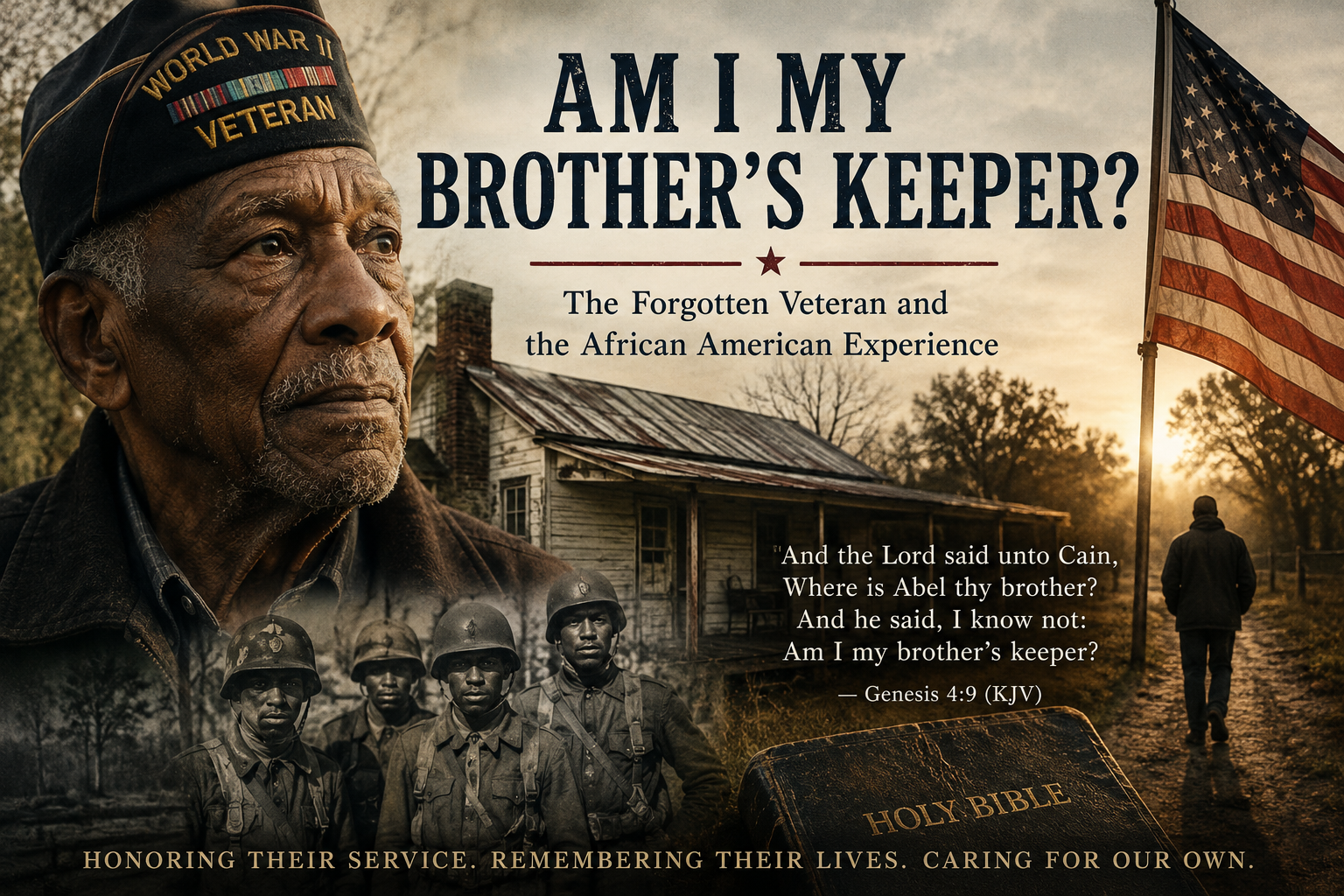
Pip: There’s a question from Genesis that has outlasted empires, denominations, and apparently most of our civic planning — “Am I my brother’s keeper?” Samp takes that question and plants it squarely in Newton County, Mississippi, and the result is not comfortable.
Mara: This episode follows that question into the history of African American veterans — who they were beyond the uniform, what communities owe them, and what happens when that obligation quietly goes unmet.
Pip: Let’s start with the veteran history and the moral weight sitting underneath it.
Am I My Brother’s Keeper? The Forgotten Veteran
Mara: The post opens with a tension that runs through the entire piece: African American communities have historically answered the question of mutual obligation not with declarations but with survival — stretching resources, feeding neighbors, burying the dead.
Pip: And then it anchors that abstraction in one specific, devastating case. The setup is January 1985, Newton County, Mississippi, record cold. The post puts it plainly: “How does a man who served his country during World War II freeze to death alone in his own home?”
Mara: That’s the question the piece refuses to let go of. J. T. Collier, seventy-two years old, a World War II veteran, was found dead inside his Lawrence, Mississippi home. No electricity. A small gas heater. The cold had simply proven too much.
Pip: And to the post’s credit, it doesn’t assign blame cleanly. It says history requires humility — we don’t know who checked on him, who tried, who cared. What we know is only the outcome.
Mara: That restraint matters, because the piece is making a larger argument about structural isolation, not individual failure. It traces what it calls a cycle: children move away, church memberships shift, lifelong friends pass, health declines, and a person who was once surrounded by family and faith quietly slides into solitude.
Pip: The church section hits hard here — historically, the Black church was the community’s nervous system. It knew who needed wood for the winter. Who simply needed someone to sit on the porch.
Mara: The post is explicit about what African American veterans returned to after World War II. They came back not to prosperity but to farms, timber jobs, small rural congregations. The piece lists what they actually were: farmers, teachers, deacons, mechanics, grandparents. “The military was merely one chapter of their lives, not the entirety of their identity.”
Pip: And then the chapters stopped being written down.
Mara: The post frames remembrance as something that has to be active and present-tense — not flags on graves, but checking on the elderly before the dangerous weather arrives. “The true measure of gratitude is not what we do after a veteran has passed away. It is what we do while they are still here.”
Pip: Cain never got a direct answer from God. The post points out that Scripture just keeps showing you what the answer looks like in practice — feed the hungry, visit the sick, bear one another’s burdens.
Mara: And the piece closes by turning the question back outward. One day the cold comes for all of us, and we may find ourselves depending on someone else’s answer to that same question.
Pip: Which is either deeply reassuring or a very effective guilt delivery mechanism. Possibly both.
Mara: The obligation the post describes doesn’t expire when the ceremony ends — it lives in the daily work of noticing who’s still here.
Pip: Next time, we’ll see what other corners of that history are still waiting to be looked at directly.
Leave a Reply