the unwritten laws of newton county
what one man’s death certificate reveals about the jim crow south
“History is not only the search for answers; it is also the discipline of knowing where the evidence ends.”
When we research family history, we often look for life’s quiet milestones—the purchase of land, the birth of children, a growing household in the census, or the gradual accumulation of property. These records tell us how our ancestors endured hardship and built lives for themselves despite enormous obstacles.
For years, the surviving records of Richard David Ware of Newton County, Mississippi, appeared to tell exactly that story.
Born just after the Civil War, Richard grew into adulthood during Reconstruction. He learned to read and write, married his wife Laura (also recorded as Lena), and built a farming operation in the Lawrence community. Like countless African Americans of his generation, he sought stability through family, faith, and land ownership.
Then, in 1917, the family’s world changed forever.
According to contemporary newspaper accounts, one of Richard’s daughters was accused of being sexually assaulted by James Marshall, a young man who had reportedly lived with the Ware family “almost as one of the family.” Richard confronted Marshall on a rural road and fatally shot him before voluntarily surrendering to local authorities.
The legal system moved quickly. Richard pleaded guilty to manslaughter and was sentenced to two years in the Mississippi State Penitentiary.
Yet something remarkable happened.
Citizens of Newton County petitioned Governor Theodore G. Bilbo for Richard’s release, describing him as a man of “good reputation for honesty, peaceableness and general well doing.” The petition argued that the extraordinary circumstances surrounding the case warranted mercy and went even further, asserting that had Richard been a white man, he likely would never have been indicted or convicted.
Governor Bilbo granted the pardon.
Richard returned home.
He resumed farming, purchased $500 in Fourth Liberty Loan Bonds during World War I, and by 1920 owned his farm completely free of debt.
It appeared to be a story of tragedy followed by redemption.
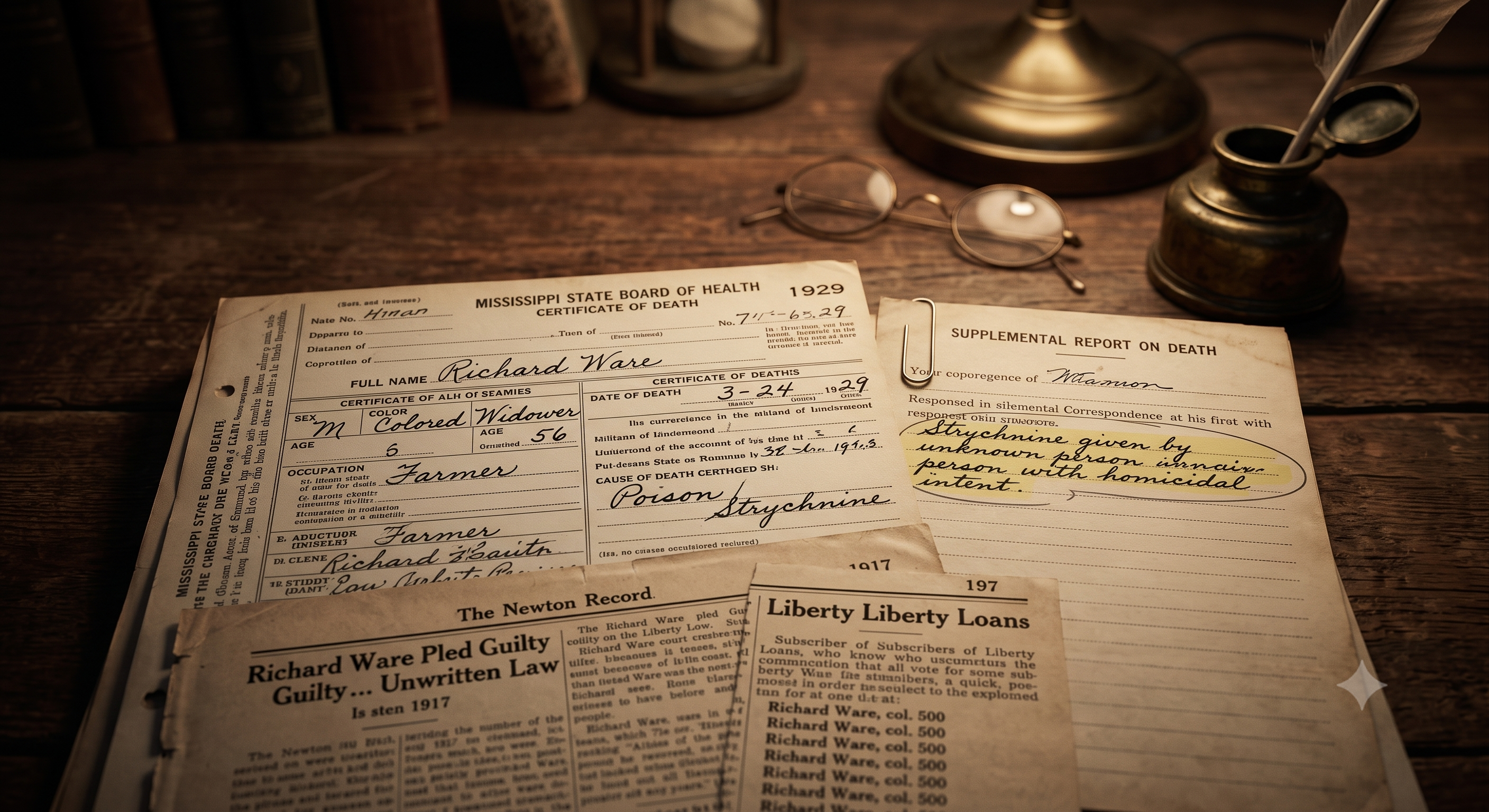
Then I found his death certificate.
The Document That Rewrote the Ending
At first glance, Richard Ware’s death certificate looked ordinary.
It listed his occupation as a farmer.
It identified his parents.
It recorded his burial.
The cause of death simply read:
Poison.
Nothing about the front of the certificate suggested that Richard’s story ended any differently than thousands of others recorded during that era.
Then I turned the page.
Attached to the certificate was correspondence between the Mississippi State Board of Health and Richard’s attending physician.
The physician explained that an autopsy had been performed. Richard’s stomach had been removed and forwarded to the Mississippi State Chemist for laboratory analysis.
The results identified the poison as strychnine.
During the early twentieth century, strychnine was widely available throughout rural America. Farmers commonly used it to kill rats, moles, and other pests, while physicians occasionally prescribed it in extremely small medicinal doses. In larger quantities, however, it became one of the deadliest poisons known. It attacks the central nervous system, causing violent muscle spasms, painful convulsions, and respiratory failure. Victims often remained conscious throughout much of the poisoning, making death particularly agonizing.
When state officials requested additional clarification, the physician responded with seven unforgettable words:
“Strychnine given by unknown person with homicidal intent.”
In a single sentence, Richard Ware’s story changed forever.
The Double Standard of the “Unwritten Law”
Richard’s death certificate raises important questions, but to understand its significance, we must first revisit the world in which he lived.
When Richard surrendered after killing James Marshall in 1917, he relied upon what Southerners often called the “unwritten law.” Although never formally enacted, it reflected the widespread belief that a man was justified in using deadly force to defend the honor of his wife or daughter.
Historically, however, that unwritten law was not applied equally.
White men who claimed to be protecting their families frequently received sympathy from juries, prosecutors, and judges.
Black men rarely did.
That is what makes Richard Ware’s case so extraordinary.
The petition submitted on his behalf did more than request mercy. It openly acknowledged what many people in Newton County already understood—that race shaped justice. The petition argued that had Richard been white, he likely would never have been indicted or convicted.
Those words exposed, with remarkable honesty, the unequal administration of justice during the Jim Crow era.
Richard ultimately received a pardon, but his freedom depended not upon equal treatment under the law. It depended upon his reputation, the willingness of neighbors to advocate for him, and the discretion of the governor.
Justice was not guaranteed.
It was negotiated.
Success Did Not Eliminate Vulnerability
By every outward measure, Richard appeared to have rebuilt his life.
He had survived imprisonment.
He had regained his freedom.
He owned his land outright.
He had earned the respect of his community.
Yet his death certificate reminds us that success did not erase vulnerability.
Richard’s life illustrates a difficult truth about the Jim Crow South: economic achievement, literacy, property ownership, and community respect could improve one’s circumstances, but they could not eliminate the dangers created by an unequal society.
One detail on the death certificate quietly underscores that vulnerability.
By 1929, Richard was listed as a widower.
His wife Laura had died in 1927, leaving him without the lifelong partner who had shared every stage of building their family and farm. The records do not tell us what life looked like during those final years, but they remind us that Richard faced the end of his life alone.
The Silence of the Archives
Perhaps the most haunting aspect of Richard Ware’s story is not the poisoning itself.
It is the silence that follows.
The physician concluded that Richard had died after receiving strychnine administered by an unknown person with homicidal intent.
Yet today, no surviving records have been located documenting an arrest, indictment, or criminal prosecution connected to his death.
No identified suspect.
No known trial.
No recorded resolution.
Whether investigators were unable to identify the person responsible, whether the investigation simply reached a dead end, or whether records have been lost over time remains unknown.
The documentary record grows remarkably quiet precisely where we hope it would speak the loudest.
For historians and genealogists, that silence is itself part of the story.
The Temptation to Fill in the Blanks
Family historians naturally want complete stories.
When I discovered that Richard’s household included a young grandson named William Marshall in the 1920 census, I immediately wondered whether he might somehow be connected to James Marshall.
The surname was the same.
The timing invited questions.
But questions are not evidence.
At present, no surviving records identify William Marshall’s parents, and the census chronology does not perfectly align with the events of 1917. Perhaps future records will answer that question.
Perhaps they will not.
Good history requires us to distinguish carefully between what the evidence proves and what it merely suggests.
Sometimes the most honest sentence a historian can write is:
We simply do not know.
What Richard Ware’s Story Teaches Us
Richard Ware’s story ultimately reaches beyond one family.
It reminds us that progress was never guaranteed. A man could build a debt-free farm, earn the respect of his neighbors, and still remain vulnerable to forces beyond his control.
It reminds us that justice in the Jim Crow South was not equally available to everyone. Richard’s own pardon was secured through community advocacy rather than equal application of the law, while the circumstances surrounding his own death remain unresolved.
Most importantly, it reminds us that historical records are rarely complete.
Every census.
Every court record.
Every newspaper article.
Every death certificate.
Each preserves only part of a person’s life.
Only when those fragments are brought together do forgotten lives begin to emerge from the archives.
Richard Ware’s legacy is larger than the tragedies that marked both the middle and the end of his life. He was a husband, a father, a farmer, a landowner, and a respected member of his community who endured extraordinary hardship while continuing to rebuild his life.
His story also reminds us of something every historian eventually learns:
History is not only the search for answers. It is also the discipline of knowing where the evidence ends.
Sometimes the archives give us certainty.
Sometimes they leave us with enduring mysteries.
And sometimes, as in the case of Richard Ware, one forgotten death certificate changes everything we thought we knew.
Sources Consulted
This article is based on the following historical records:
- 1900, 1910, and 1920 U.S. Census records, Newton County, Mississippi (Richard D. Ware household).
- Newton County marriage records.
- The Newton Record (Newton, Mississippi), August 1917, reporting the James Marshall homicide and Richard Ware’s surrender.
- Newton County Circuit Court records, State of Mississippi v. Richard D. Ware (1917).
- Petition to the Mississippi Board of Pardons requesting executive clemency for Richard D. Ware.
- Executive pardon issued by Governor Theodore G. Bilbo, October 1917.
- The Newton Record, October 1918, reporting Richard Ware’s purchase of Fourth Liberty Loan Bonds.
- Mississippi Death Certificate for Richard David Ware (March 27, 1929), including attached correspondence from the Mississippi State Board of Health and Dr. J. Stennis regarding the toxicological findings.
- Union Chapel Methodist Church Cemetery records, Lawrence, Mississippi.
Author’s Note: This article distinguishes between documented historical evidence and informed historical interpretation. While Richard Ware’s death certificate concludes that he died from strychnine administered “by unknown person with homicidal intent,” no surviving records have yet been located identifying a suspect or documenting the outcome of any criminal investigation.
Leave a Reply