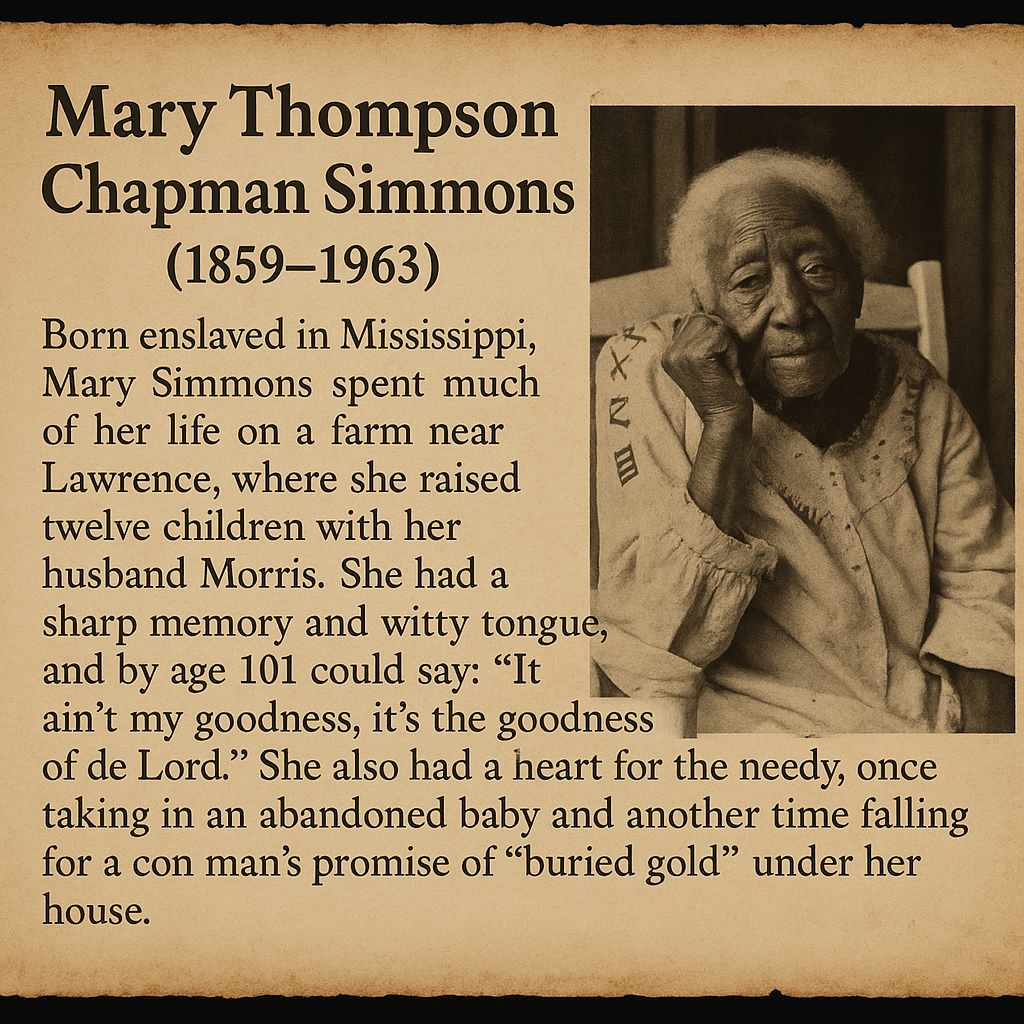
How a 101-year-old woman’s interview preserved one of Newton County’s last firsthand memories of slavery
“It ain’t my goodness; it’s the goodness of de Lord.”
— Mary Thompson Simmons, age 101
There are moments in genealogy when a faded census record suddenly becomes a person. When a birth certificate becomes a story. When an old newspaper stops being history and becomes a conversation across generations. That happened to me when I discovered a newspaper interview with Mary Thompson Chapman Simmons, affectionately known throughout the Lawrence community in Newton County, Mississippi, as “Aunt Mary.”
For years, I had reconstructed Mary’s life from census records, marriage records, cemetery inscriptions, and family histories. I knew she was born on January 13, 1859, married Morris Simmons, raised twelve children, and lived to the remarkable age of 104. I knew she was a faithful matriarch, a devoted member of Union Chapel Methodist Church, and a respected figure in her community.
But this newspaper did something no government record ever could: it preserved something almost impossible to recover today—a woman born into slavery describing her own childhood, her faith, and her life in her own words.
For historians and genealogists, documents like this are priceless. Census records tell us where people lived. Deeds tell us what they owned. Death certificates tell us when they died. But interviews preserve something those records cannot—the human voice. They reveal what people remembered, what they believed, what made them laugh, and how they understood the world around them. In doing so, this interview preserved one of Newton County’s last firsthand voices from the era of slavery.
A Visit to Aunt Mary’s Porch
The reporter didn’t find Aunt Mary in a museum or an archive. He found her sitting on the screened porch of her daughter Lucy Evans’s home just south of Lawrence, enjoying a slice of watermelon on a warm Mississippi day. Knowing visitors were coming, she had exchanged her everyday cotton dress for a pink housecoat and pinned a flower to her lapel.
Around her gathered four generations of family—children, grandchildren, great-grandchildren, and great-great-grandchildren. The scene was ordinary, yet extraordinary. She was 101 years old. Today, we marvel at interviews with people born during the Great Depression. The reporter who visited Aunt Mary was speaking with a woman who had been born before the Civil War.

A Childhood Born Into Slavery
Mary Thompson Simmons entered the world in 1859, six years before slavery ended in the United States. Unlike many historical accounts that describe slavery in broad terms, Mary’s memories were deeply personal.
She remembered life during slavery—the chopping of cotton, spinning thread on a wheel, weaving cloth on a loom, baking hoe cakes in the ashes, riding astride a mule, and attending neighborhood square dances. These were not stories handed down through generations; they were memories she had carried for more than a century.
Each recollection offers a rare glimpse into everyday life in Newton County during one of the darkest chapters in American history. Rather than focusing on political events, Mary’s memories reveal the ordinary routines that shaped the lives of enslaved families—work, food, worship, and community. History often speaks in dates. Mary spoke in memories.
Worship Behind the Line of Segregation
One of the most revealing portions of the interview concerns church. Mary remembered attending Bethel Baptist Church, where white and Black worshippers gathered under the same roof. Yet even in worship, slavery drew its lines: enslaved people were required to sit in a section reserved for them. She also recalled baptisms held in a nearby pond, memories that remained vivid decades later.
Those few recollections tell us something profound. Even under slavery, faith remained central to the lives of African American families. Church was more than a place of worship—it was a place where hope endured.
Later in life, Mary and her husband, Morris Simmons, became devoted members of Union Chapel Methodist Church, where she remained active for the rest of her life. Her journey—from worshipping in a segregated section during slavery to helping sustain the church community at Union Chapel—reflects the remarkable transformation experienced by many formerly enslaved families after emancipation.
“I Learned My ABCs Listening”
Perhaps no statement in the interview better captures the legacy of slavery than Mary’s comments about education. She explained that she never attended school herself. Instead, she learned her ABCs by listening while white children received the education she was denied.
Imagine that scene: a young Black girl standing close enough to hear lessons she was not permitted to join. The opportunity for formal education had been denied to her, but Mary refused to let that become her children’s story. The newspaper noted that she insisted all of her children attend school. That single decision may have changed the trajectory of the Simmons family for generations.
Many African American parents who had been denied education themselves became fierce advocates for schooling after emancipation. They understood that literacy represented more than reading and writing—it represented opportunity, independence, and hope. Mary’s determination reminds us that the pursuit of education in Black communities did not begin in classrooms. It began with parents who believed their children deserved opportunities they themselves had never been given.
“It Ain’t My Goodness”
Naturally, the reporter asked the question nearly everyone asks someone who has lived beyond one hundred years. What was her secret? Mary smiled and answered with characteristic humility:
“It ain’t my goodness; it’s the goodness of de Lord.”
There was no elaborate explanation. No miracle diet. No secret formula. Only faith. Throughout the interview, she consistently redirected attention away from herself and toward God. That simple answer may explain more about Mary’s life than any biography ever could.
One of the interview’s most touching moments came when Aunt Mary began singing. Softly, she sang verses of “When the Saints Go Marching In.” Looking toward the blue Mississippi sky, she said:
“I want to be in that number… It’s hallelujah time, and I want to meet my folks in that Great World up yonder.”
For a woman who had buried her husband and six of her children, heaven was not an abstract theological idea. It was the place where she expected to see her loved ones again.
A Century of Extraordinary Change
Mary Thompson Simmons was born before Abraham Lincoln became president. She was a young child when the Civil War erupted, and slavery came to an end. She lived through Reconstruction, watched Jim Crow reshape the South, witnessed the arrival of railroads, automobiles, electricity, radio, airplanes, antibiotics, and television, and lived long enough to see the early years of the modern Civil Rights Movement.
Yet the reporter seemed most impressed not by the history she had witnessed, but by the woman herself. She rose early, listened to the radio, proudly displayed a quilt she had pieced together at ninety-six years of age, and laughed that she would only ride in an airplane if she were “tied down.” Despite surviving enormous social change, she remained remarkably content, grateful, and grounded.
As the interview drew to a close, Aunt Mary left younger generations with simple advice:
“Read yo’ Bible. Go to church. Never cuss in front of your mama… People are not like they used to be. They ain’t good.”
Whether one agrees with her assessment or not, those words remind us that every generation worries about what the next generation may lose. For Mary, character mattered more than wealth, faith mattered more than comfort, and family mattered more than possessions.
Why Aunt Mary’s Voice Still Matters
As family historians, we spend countless hours reconstructing lives from census schedules, deeds, military records, obituaries, and cemetery markers. Those records tell us when people lived. This interview tells us how Mary lived. It preserves her memories, her humor, her theology, her wisdom, and most importantly, her own voice.
When Mary Thompson Simmons passed away on October 31, 1963, at the age of 104, Newton County lost one of its last living witnesses to slavery. Thankfully, one reporter took the time to sit on a quiet porch in Lawrence, Mississippi, ask thoughtful questions, and listen. Because he listened, we can still hear Aunt Mary today.
Only One Lifetime Away
While researching my family’s history, I made a discovery that forever changed how I think about the past: I was born in 1963. Mary Thompson Simmons—a woman born into slavery in 1859—died that same year.
We never met, yet for a brief moment, our lives shared the same year on this earth. That realization collapsed more than a century of history into a single moment. Slavery no longer felt like a distant chapter in an American history textbook; it became part of my own family’s living memory.
That is why this interview matters. It reminds us that history is often much closer than we imagine. Sometimes, it is only one lifetime away.
Join the Discussion
Have you ever discovered a document that transformed the way you viewed an ancestor—or your community’s history? I’d love to hear your story in the comments below. Sometimes the most remarkable discoveries aren’t found in famous archives, but in a forgotten newspaper clipping, a family Bible, or the remembered words of someone whose voice almost slipped away.
Leave a Reply