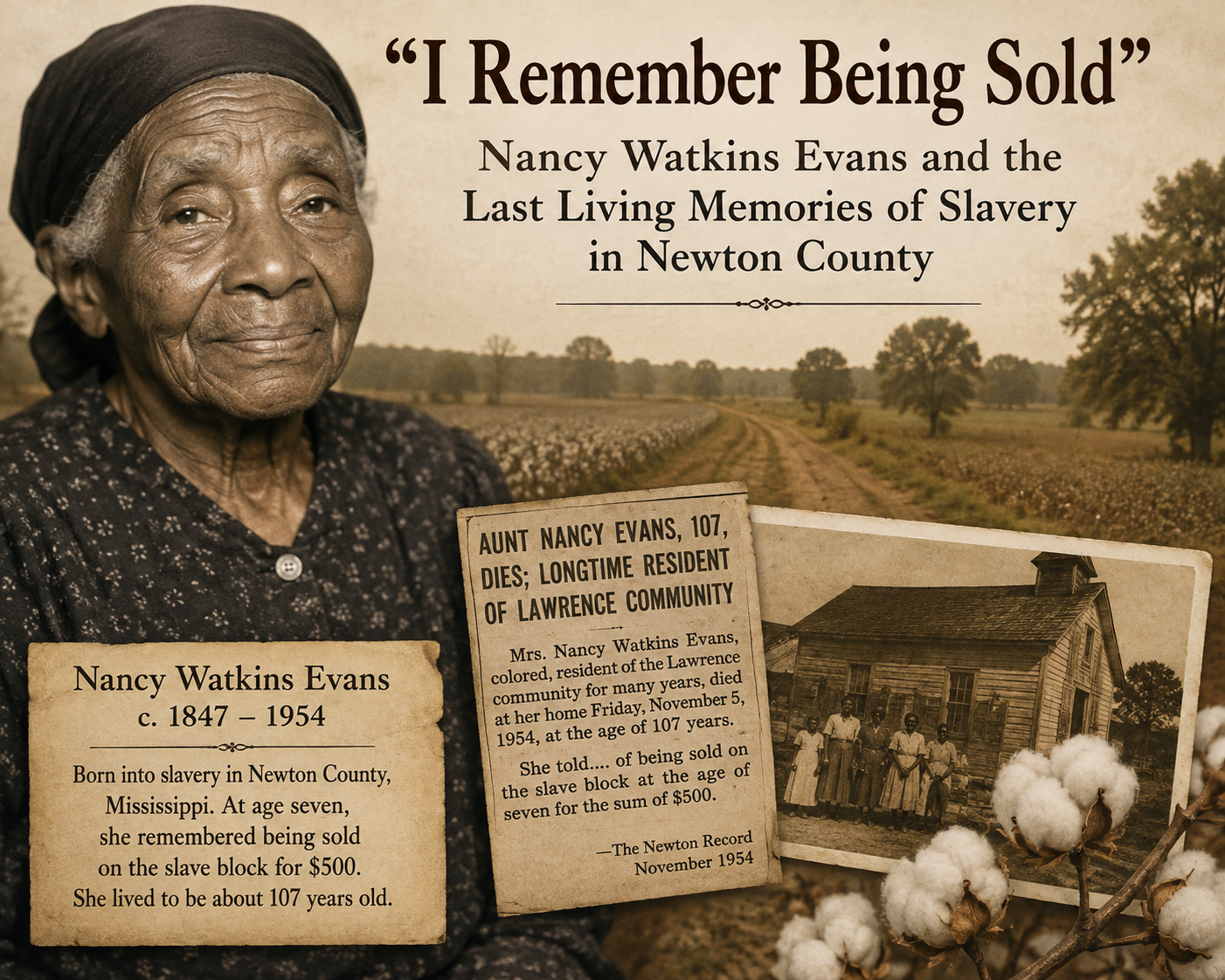
Pip: There's a particular kind of history that doesn't live in courthouse files — it lives in the memory of a seven-year-old girl who never forgot one morning in Newton County, Mississippi.
Mara: This episode follows Samp's work documenting that memory — the life of Nancy Watkins Evans, a woman who survived slavery, built a family, and carried a firsthand witness account into the twentieth century. Let's start with the story itself.
I Remember Being Sold
Pip: The question this post sits with is a hard one: what does it mean when a living person is the last surviving bridge between the present and an institution we call history? Nancy Watkins Evans was born around 1847 into slavery in Newton County, Mississippi, and she died in 1954 at roughly 107 years old — still carrying one specific memory from childhood.
Mara: Her obituary, published in November 1954, recorded it plainly: "She told… of being sold on the slave block at the age of seven for the sum of $500."
Pip: That's not a document from the antebellum era. That's a newspaper from the year before Rosa Parks. The distance between slavery and the present isn't measured in centuries alone — it's measured in the people our parents and grandparents actually knew.
Mara: The post traces what came after emancipation too. Around 1867, Nancy married Benjamin Evans and they built a life in the Lawrence community, raising thirteen children. Census records list her over the decades as keeping house, working as a farm laborer, and earning a living as a laundress — labor that rarely gets recognized but sustained Black families and communities throughout the rural South.
Pip: Neighbors called her "Aunt Nancy." Her obituary described her as "very frank, honest, and without hypocrisy." That's a character sketch that outlasted almost everyone who could have given it.
Mara: Her faith outlasted slavery too. She joined the Presbyterian Church young and remained devoted throughout her life, with funeral services eventually held across two churches — a detail the post uses to show how Black congregations in Newton County shared ministers, revivals, and funerals across denominational lines. Community held even where formal affiliation differed.
Pip: What the post keeps returning to is the irreplaceability of memory. Census records can reconstruct the outline of a life. Only Nancy could say what it felt like to be seven years old and sold away. No courthouse record preserves that.
Mara: And it survived only because a reporter sat down and listened, and a family kept the newspaper. The post closes on that point directly: "Genealogy often begins with names and dates. History truly begins when those names begin to speak."
Pip: That line does the work. On to what memory makes possible when it's finally written down.
Mara: Nancy Watkins Evans lived long enough that her childhood memory of slavery became a living thread connecting generations who never expected to touch that history directly.
Pip: The work of listening — really listening — turns out to be its own form of preservation. More of that next time.
Leave a Reply