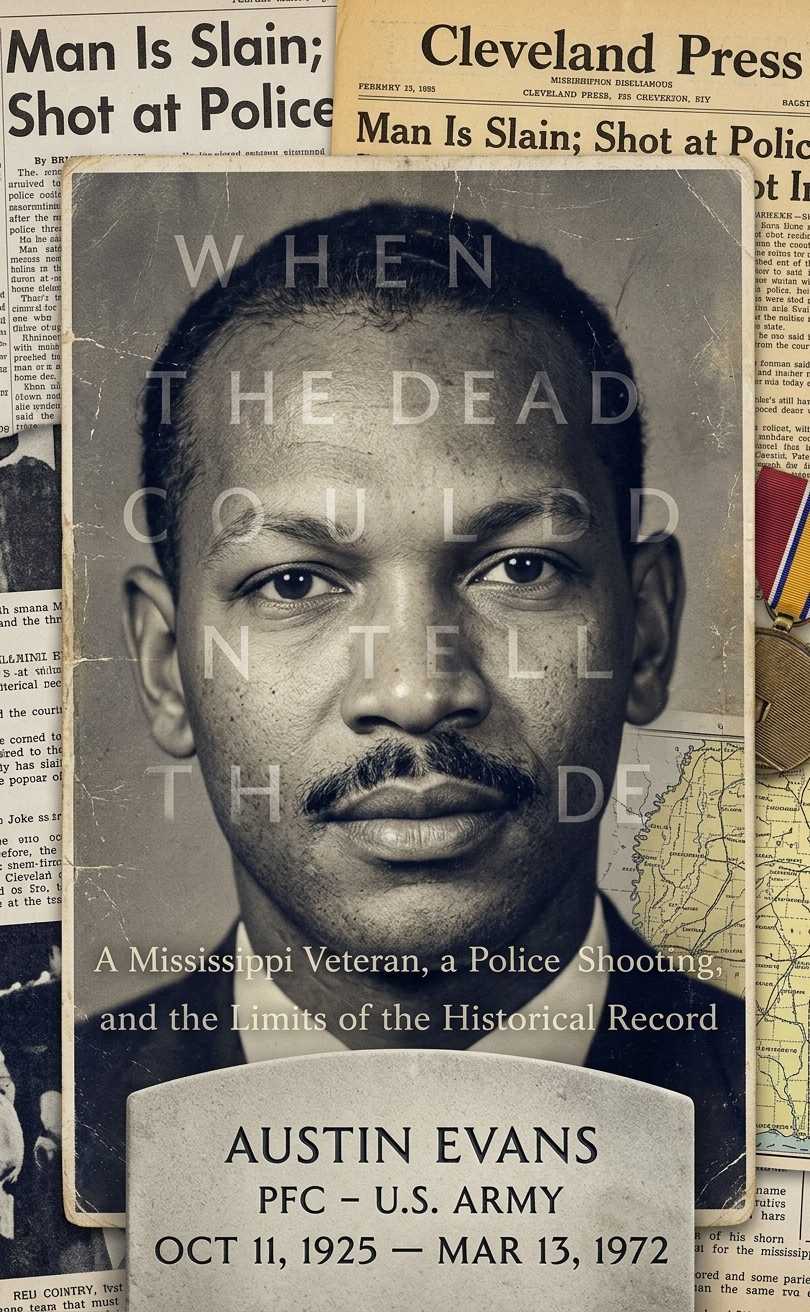
Pip: There is a particular kind of archive silence — not the absence of records, but the presence of records that only tell one side. That is the territory Samp is working in this week.
Mara: The episode centers on what the historical record can and cannot tell us — how official accounts get preserved, who gets to speak in them, and what responsible family history owes the people it reconstructs.
Pip: Let's start with Austin Evans, a Mississippi veteran, and the question of whose version of events becomes history.
When the Dead Could Not Tell Their Side
Mara: The post opens with a 1972 police shooting in Cleveland, Ohio — a Black veteran from Newton County, Mississippi, killed after officers say he fired first. The central question it raises is whose version of events survives when one of the central figures does not.
Pip: And the post is careful about how it frames that question. It draws a line between cynicism and critical analysis — which is a harder line to hold than it sounds.
Mara: The post puts it directly: "That does not mean that the officers' account was false. But neither should the existence of an official account be confused with the existence of a complete account."
Pip: So the argument is not that the officers lied. It is that Austin Evans never had the opportunity to say anything at all.
Mara: Exactly, and the post makes the evidentiary gap concrete. There were no body cameras, no smartphones, no independent visual record. The surviving account rests entirely on statements from officers, investigators, witnesses, and journalists. That is not a scandal — it is just what 1972 looked like.
Pip: What the post does well is refuse to let that gap become the whole story — in either direction.
Mara: Right. And then it pulls back to show you the life before the headline. Austin was born in Lawrence, Mississippi, attended Lawrence Colored School, and entered the Army in March 1945 — serving under segregation, more than a year before Truman's executive order would begin to change that.
Pip: A man who served a country that had not yet desegregated its own military. That detail does real work.
Mara: After his discharge in 1947, he married, worked as a welder in Cleveland, and was part of a broader family migration — siblings in San Francisco and Chicago, while their mother Fannie remained in Lawrence until her death in 1964 following a car accident.
Pip: And then, less than eighteen months after Austin's death, his son Clayborne — also a veteran — died from a gunshot wound in Texas. The post names this plainly: a mother, her son, and her grandson, three sudden deaths within nine years.
Mara: The post closes with what it calls the obligation of family history: "We owe Austin accuracy. We owe him context. We owe him the distinction between 'police reported' and 'this unquestionably happened.'" And equally, it says, we owe the surviving officers the same historical fairness.
Pip: The military marker at Highland Park Cemetery lists his name, rank, and service. The newspapers preserved his final minutes. The post is making the case that neither record is the whole person.
Mara: And that restoring the rest — the childhood, the migration, the marriage, the fatherhood — is precisely what family history is for.
Pip: The question underneath all of this is what we do when the archive speaks loudly about how someone died and almost not at all about how they lived.
Mara: The answer the post keeps returning to is: you keep looking, and you hold your conclusions carefully.
Pip: Until next time.
Leave a Reply