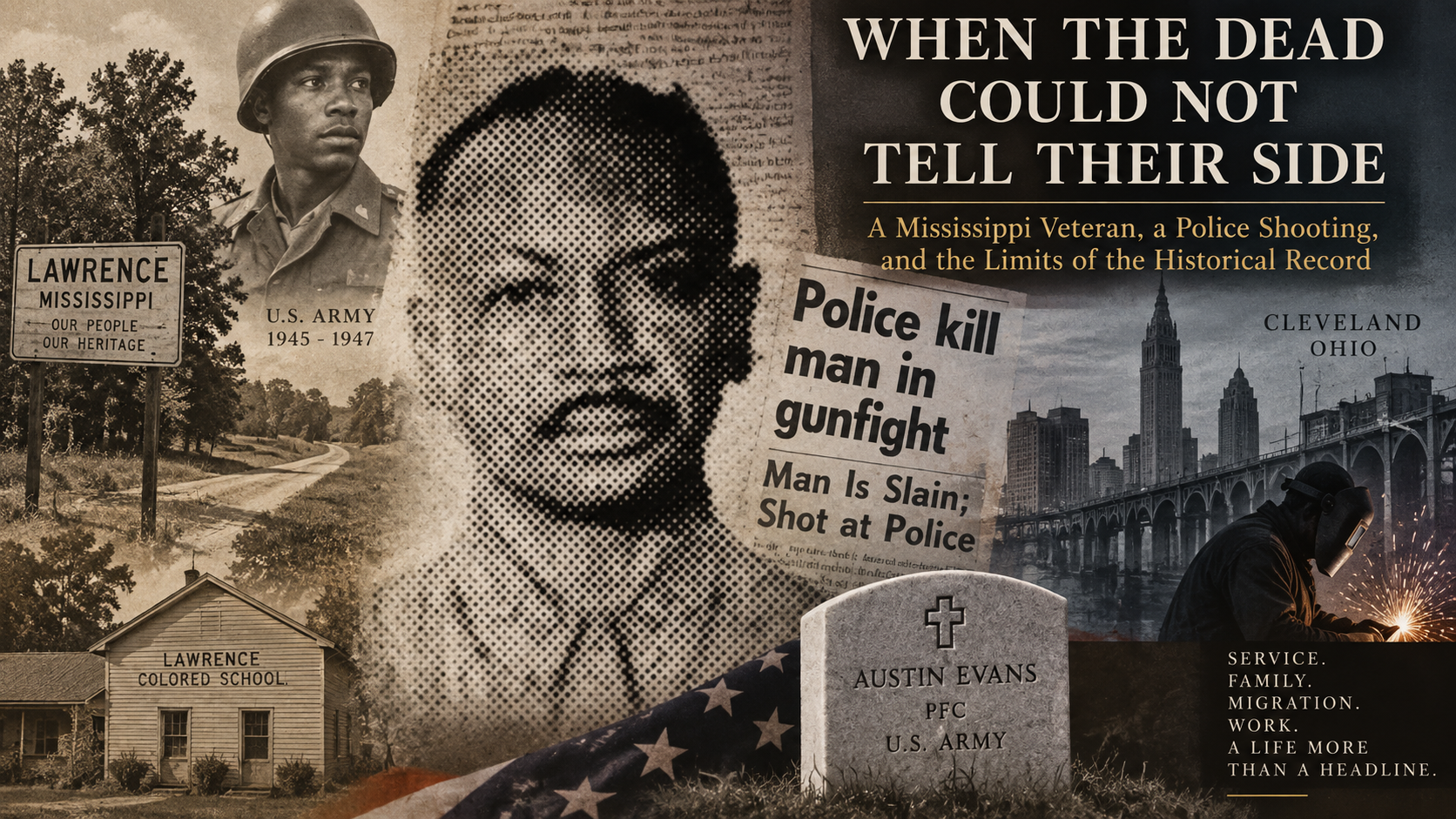
A Mississippi Veteran, a Police Shooting, and the Limits of the Historical Record
On March 14, 1972, readers in Cleveland, Ohio, opened their newspapers to stark headlines:
“Man Is Slain; Shot at Police.”
“Police Kill Man in Gunfight.”
The man was Austin Evans, a 45-year-old Black native of Lawrence, Newton County, Mississippi.
According to contemporary newspaper reports, Austin fired a .25-caliber pistol at Cleveland Patrolman Bernard T. Ferris from close range. The bullet reportedly passed through the officer’s cap and struck the wall behind him. Ferris and fellow Patrolman Daniel D. Rood returned fire, each reportedly firing four shots. Austin was struck five times in the chest and abdomen and taken to Mount Sinai Hospital, where he died that evening.
By the following morning, The Cleveland Press reported that the police prosecutor had reviewed the incident and ruled the shooting justifiable.
For more than half a century, that account remained the version preserved in the surviving newspaper record. Yet for researchers and family historians, Austin’s death raises a fundamental question:
Whose version of events becomes history when one of the central figures does not survive to tell his side?
The Limits of the Official Record
Evaluating historical sources requires a careful boundary between cynicism and critical analysis.
The surviving 1972 newspaper accounts are generally consistent about the broad sequence of events. Police were contacted after Roberta Worth, identified in the newspapers as Austin’s common-law wife, sought assistance at the Glenville Police Community Outreach Center. She reportedly told police that Austin had been drinking, had forced her from the residence, possessed a firearm, and had threatened her.
Officers accompanied her to the residence at 10217 Pierpont Avenue N.E.
According to Patrolmen Ferris and Rood, they announced themselves and entered after receiving no response. The officers reported that Austin came from the darkened kitchen carrying a .25-caliber pistol. They said they ordered him to drop the weapon.
According to their account, Austin fired first.
The bullet reportedly passed through Ferris’s cap without striking him. The two officers then returned fire.
These newspaper reports are essential pieces of the historical record. They tell us what police, investigators, witnesses, and reporters recorded at the time. But another fact is equally important: Austin Evans never had the opportunity to give his account of what happened.
There Was No Camera Inside 10217 Pierpont Avenue
Austin died in a very different evidentiary world from the one we know today. There were no smartphones, body-worn cameras, or instant digital recordings to capture what transpired inside that hallway.
Today, video evidence frequently provides an additional lens when accounts of police encounters differ—sometimes corroborating official reports, and other times offering critical context or contradicting initial statements. Austin’s death occurred decades before such technology became commonplace.
The surviving public account therefore depends heavily upon statements made by the officers, investigators, witnesses, and journalists who documented the incident. There is no independent visual record against which those accounts can now be compared.
That does not mean that the officers’ account was false. But neither should the existence of an official account be confused with the existence of a complete account.
Responsible history requires us to avoid two opposing errors: accepting every statement preserved in an archive as unquestionable truth, or alleging misconduct for which we have no evidence.
Perhaps the confrontation happened exactly as the officers described it. Perhaps there were details that were never recorded. Perhaps another person standing in the room would have remembered some moments differently.
More than half a century later, the surviving evidence does not allow us to answer every question. Acknowledging that silence is not a weakness of historical research; it is an act of intellectual integrity.
Before Austin Evans Became a Headline
There is another danger in relying too heavily upon newspaper accounts of violent deaths: a person can become defined entirely by the worst—or final—minutes of his life.
Austin Evans had lived for more than four decades before his name appeared beneath those Cleveland headlines.
He was born on November 17, 1925 or 1926, in Lawrence, Mississippi, the son of William and Fannie E. Evans. The surviving records disagree by one year on his birth: his World War II draft registration gives 1926, while his military headstone application gives 1925. As a young man, Austin attended Lawrence Colored School, receiving his education within Mississippi’s segregated school system.
His draft registration captures him at the threshold between childhood and adulthood. He was still a student in Lawrence when the United States was fighting World War II.
Then Austin himself entered military service.
Serving a Country That Had Not Yet Desegregated Its Military
On March 17, 1945, Austin entered the United States Army during the closing months of World War II. He eventually attained the rank of Private First Class and remained in military service until his honorable discharge on January 20, 1947.
Austin’s dates of service place his military experience within an important period of American history. President Harry S. Truman would not issue Executive Order 9981, establishing a policy of equality of treatment and opportunity in the armed forces, until July 26, 1948—more than a year after Austin left the Army. The process of military integration itself continued long afterward.
Austin therefore served his country while its armed forces still operated under racial segregation. That fact deserves a place in his story. The young Black man from Lawrence Colored School had entered the uniform of the United States Army during a world war, served through the immediate postwar period, and returned home before the nation formally committed itself to ending segregation within its military.
From Mississippi to Cleveland
After his military service, Austin returned to civilian life. He married Mary E. Love, and by 1950 he was living in Meridian, Lauderdale County, Mississippi, where records document him working as a yardman and helper for a florist.
Eventually, Austin joined the movement of Black Southerners leaving Mississippi for opportunities elsewhere. He settled in Cleveland, Ohio, where he worked as a welder.
His journey was part of a much larger family movement. Austin’s brother, T. L. Evans, eventually lived in San Francisco, California. His sister, Francis Evans Bridges, settled in Chicago, Illinois.
Three children who had grown up in the same Mississippi family had established lives across three distant American cities: San Francisco, Chicago, and Cleveland. Their mother remained in Lawrence.
The Mother Who Stayed Behind
Fannie E. Evans remained deeply connected to the community her children had left. She was a member of Union Chapel Methodist Church and was remembered in her obituary as a devoted Christian, friend, and neighbor who was “always ready to help those in need.”
Then tragedy reached the Evans family.
On November 7, 1964, Fannie died following an automobile accident. Her death was sudden. Her obituary named the three children who survived her: T. L. in California, Francis in Illinois, and Austin in Ohio.
Eight years later, another unexpected death would strike the family. This time it was Austin.
A Soldier Buried After a Police Shooting
Whatever occurred during those final moments inside the Pierpont Avenue residence, Austin’s military service followed him to the grave.
Nine days after his death, an application was submitted for a government-issued military marker. The document recorded his Army service and requested a flat granite marker bearing a Christian cross for his grave at Highland Park Cemetery in Cleveland.
The marker identified the former Mississippi schoolboy simply by his name, rank, and military service:
PFC — U.S. ARMY
There is something poignant in the contrast between the two kinds of records left behind. The newspapers preserved the violent final minutes of Austin’s life. The military record preserved his service to his country.
Neither record told his entire story.
And Then His Son
The Evans family’s experience with sudden death did not end with Austin.
Austin and Mary Love Evans had a son named Clayborne Evans, born in Mississippi on December 1, 1948. Like his father, Clayborne entered the United States Army.
And like his father, Clayborne would die from gunfire.
On September 2, 1973—less than eighteen months after Austin’s death—24-year-old Clayborne suffered a gunshot wound to the abdomen following an altercation in Schertz, Guadalupe County, Texas. He was transported to Brooke Army Medical Center at Fort Sam Houston, where he died from blood loss.
His Texas death certificate classified the death as a homicide. The document also provides an unmistakable connection between father and son:
Father: Austin Evans
Mother: Mary Love
Clayborne’s body was returned to Cleveland for burial.
Three Generations, Three Sudden Deaths
Placed individually in a genealogical file, the records seem to document three separate events.
Fannie Evans died following an automobile accident in 1964. Eight years later, her son Austin was fatally shot by Cleveland police. Less than eighteen months afterward, Austin’s 24-year-old son Clayborne died from a gunshot wound following an altercation in Texas.
Placed beside one another, however, the records reveal something much more painful: a mother, her son, and her grandson—three lives ended suddenly within nine years.
And running through the lives of the two men was another shared experience. Both Austin and Clayborne served in the United States Army. Neither lived to grow old.
What Do We Owe Austin Evans?
Perhaps the most important question is not whether we can determine exactly what happened inside Austin’s Cleveland residence on March 13, 1972. We may never be able to.
The more important question for a family historian is what we owe the person whose life we are reconstructing.
We owe Austin accuracy. We owe him context. We owe him the distinction between “police reported” and “this unquestionably happened.” At the same time, we owe the surviving officers that same historical fairness. We should not accuse them of dishonesty or misconduct without evidence simply because later generations have seen other police accounts challenged by modern recording tools.
Historical skepticism should work in both directions: we should question our sources, but we should also question our assumptions.
Most importantly, we owe Austin a life larger than the circumstances of his death.
The Life Before the Headline
Austin Evans was not born on March 13, 1972.
He was born in Lawrence, Mississippi. He was somebody’s son. He attended school. He entered the United States Army while his country’s military remained segregated. He became a husband and father. He worked. He migrated from Mississippi to Ohio and became a welder. He lost his mother suddenly. He had a son who followed him into military service.
Somewhere along that journey, nearly half a century of living was reduced in the public record to a few newspaper columns describing the night he died. Family history gives us the opportunity to put the rest of that life back.
At Highland Park Cemetery in Cleveland, a federal military marker remembers Austin Evans, PFC, U.S. Army. The newspapers preserved his violent final minutes; the military record preserved his service; his family’s records preserve still more—a Southern childhood, education, work, migration, marriage, fatherhood, and a family repeatedly touched by sudden loss.
The historical record does not give Austin a voice in his final moments, and responsible history should neither invent one for him nor automatically treat the surviving account as complete. What we can do is refuse to let those final minutes become the whole of his story.
The dead may not always be able to tell their side. But the records they left behind can help us restore the life that existed before the headline.
Leave a Reply